







Jewelry of Oceania: Archaeology and History of the Pacific Islands
This page is part of our series exploring the history and archaeology of the world’s civilizations, with the aim of reinterpreting some of their works as jewelry. Here, we journey through the islands of the Pacific.
The cultures of Oceania have developed highly diverse artistic forms, ranging from the Aboriginal rock paintings of Australia to the sculptures and ritual objects of the various Pacific islands. Deeply connected to nature, ancestors, and spiritual beliefs, these traditions have created an artistic heritage of exceptional richness. The motifs, materials, and symbols from these cultures provide a fascinating source of inspiration for contemporary jewelry design.
Jewelry inspired by Australian Aboriginal cultures
Australia, with its diverse landscapes and rich history, is a treasure trove of archaeological and cultural artifacts, offering a fascinating glimpse into the lives of the Indigenous peoples who have inhabited the continent for millennia. Among these peoples, the Aborigines stand out for their cultural heritage, deeply rooted in their close relationship with nature. Their art, particularly rock paintings, serves as a poignant testament to this intimate and spiritual connection with their environment.
These paintings, found in caves or rock shelters, are works of great artistic sophistication. They depict an impressive range of motifs, from animals and plants to hunting scenes and ritual ceremonies. Aboriginal artists used natural pigments, sometimes mixed with water or animal fats, and advanced painting techniques to create expressive and enduring works of art.
These rock paintings are also a means of transmitting knowledge, traditions, and stories. They reflect the depth of Aboriginal culture and its spiritual connection to the land. By studying them, we can gain a better understanding of the richness and complexity of Aboriginal civilization, as well as the importance of preserving and respecting their cultural heritage.

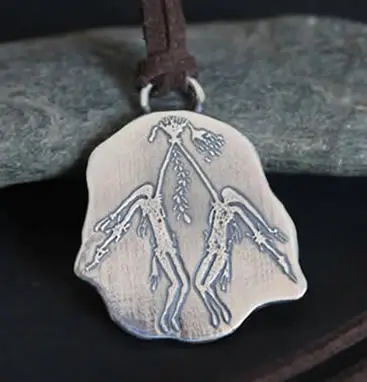
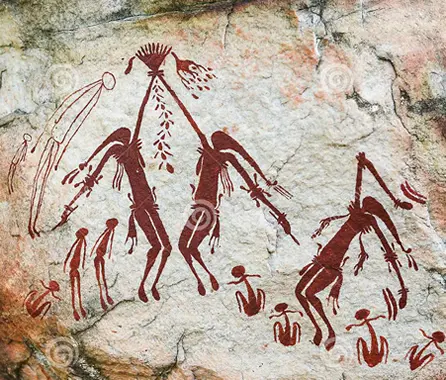
The Kiro Kiro aborigine ritual necklace is a striking example of the deep connection between the Aborigines and their natural environment. Inspired by a rock painting dating back to between 12,000 and 17,000 years BCE, this necklace serves as a poignant testament to the enduring legacy of Aboriginal culture. The Kiro Kiro rock paintings are renowned for their distinctive anthropomorphic figures, often depicted with ritual accessories such as bags, tassels, and stylized headdresses. These artistic representations are deeply rooted in rituals, initiation rites, and shamanic ceremonies, offering a fascinating insight into Aboriginal spirituality and their sacred bond with the land.
This particular painting stands out for its elegance and refinement in portraying the figures. Every detail is meticulously crafted, reimagining ancestral motifs with a contemporary sensibility. By wearing this necklace, one establishes a tangible link to their ancient traditions and beliefs. This piece of jewelry is a living connection to an ancient and venerable culture, allowing the wearer to immerse themselves in the history and spirituality of Australia’s first inhabitants.
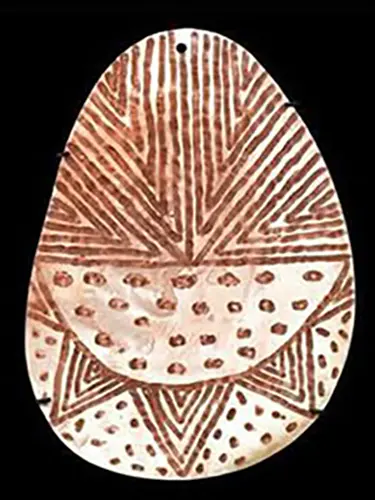
The riji is an emblematic ritual ornament of the Aboriginal peoples of the Kimberley region in northwestern Australia. It is notably associated with the Bardi, Karajarri, Nyangumarta, Jawi, Yolngu and Nyulnyul. Originally, it takes the form of a plaque or pendant carved from a mother-of-pearl shell, whose surface is carefully engraved with geometric patterns.
One of the most striking aspects of the riji is the use of mother-of-pearl, chosen for its ability to capture and reflect light. This natural brilliance, almost shifting and alive, plays an essential role in its symbolic dimension. In our silver interpretation, we sought to recreate this luminous effect by working a surface that catches and reflects light, just as mother-of-pearl did in traditional objects.
The engraved motifs on riji are composed of dots, lines and abstract shapes arranged in repetitive structures. They may evoke lightning, pathways, trajectories or natural manifestations. These forms are linked to the stories of the Dreamtime (Tjukurpa or Alcheringa), which recount the origins of the world and the actions of ancestral beings. Through these motifs, the riji becomes a visual support for these stories, as well as an object carrying memory and transmission.
Worn as a pendant or ceremonial ornament, the riji played a role in important moments such as ritual dances, initiation rites and collective ceremonies. The polished mother-of-pearl reflected the light of the sun or fire, creating visible flashes that contributed to the staging of rituals. This light is often associated with essential elements such as rain, water, rivers, clouds and lightning, which hold a central place in Aboriginal cosmologies.
Wearing a riji could also indicate a particular status, especially that of an initiated man, but also a social or spiritual belonging. It is sometimes linked to fertility, natural forces or the relationship with ancestors. Some riji were preserved and passed down, becoming objects filled with history, knowledge and tradition.
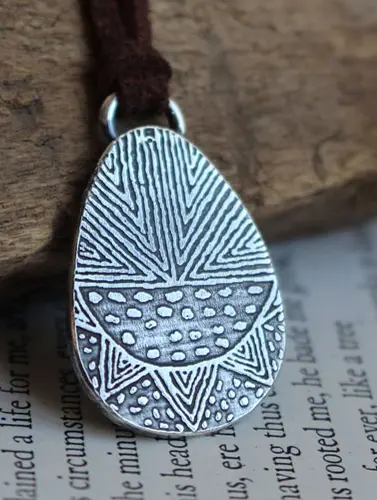
The model we have chosen to reinterpret is simply called Riji. It is distinguished by a composition structured in two parts. The upper section is formed of nested triangles, creating a repetitive and organized geometric pattern, almost hypnotic. These triangles suggest directions, trajectories or forces in motion. In the lower section, a semicircle dotted with points forms the base from which triangular shapes radiate outward. These points, arranged like a fan or a stylized sun, create a strong visual dynamic. Between these shapes, series of dots structure the composition, evoking both stars, light and symbolic pathways. This interplay of repetition, symmetry and contrast between lines and dots gives rise to a motif that is both simple and profound, where each element seems connected to the others. By translating it into silver, we sought to preserve this structure and symbolism while highlighting the light and precision of the design.
To deepen your knowledge of the art and history of Australia’s Aboriginal people, we recommend the following books:
Jewelry from Pacific Islands
Oceania, often associated with its paradisiacal islands and exotic landscapes, is a region rich in cultural traditions and craftsmanship. This vast collection of Pacific islands extends beyond its natural beauty; it is also the cradle of ancient and fascinating cultures that have left an indelible mark on local craftsmanship. While exploring this region, we were particularly captivated by the traditional objects and motifs that reflect the imagination and beliefs of Oceanian peoples.
Māori tattoos, in particular, are iconic elements of Oceanian culture. These intricate designs, often rendered in black ink, carry deep meanings and are imbued with ancestral stories. Each motif, whether spirals, geometric shapes, or stylized representations of animals, symbolizes aspects of Māori culture such as bravery, family heritage, and connections with ancestors. Inspired by these tattoos, we have designed jewelry that respectfully and aesthetically incorporates these motifs.
Beyond tattoos, Oceania offers a wide variety of traditional objects that inspire our creations. For example, jewelry made from shells, shark teeth, or carved wood plays an important role in ceremonies and rituals. Each material has its own significance and is used to symbolize natural elements or spiritual forces.
Our research into Oceanian jewelry also led us to discover other forms of craftsmanship, such as necklaces and bracelets adorned with mother-of-pearl or precious stones, which are not only objects of beauty but also serve as social and spiritual bonds within communities.
By integrating these cultural influences into our creations, we strive to pay homage to the art and traditions of the Oceanian peoples, while creating unique pieces that celebrate and perpetuate their rich heritage.

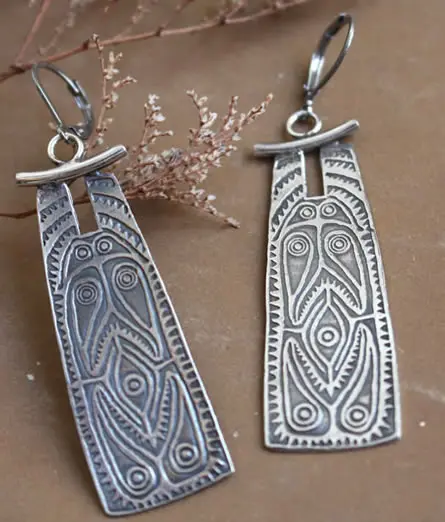
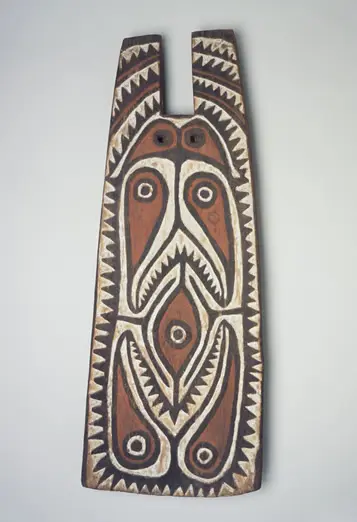
A captivating example from our collection is inspired by a traditional shield from the Elema culture, originating from the Gulf of Papua, New Guinea. This shield, with its distinctive "U" shape, is carved from wood and vibrant with colorful pigments, drawing attention with its elaborate geometric patterns and triangular friezes. What makes it particularly fascinating are the multiple eyes carved into its surfaces, each carrying profound symbolic meanings.
In Elema culture, eyes on shields and other ritual objects often symbolize vigilance, protection, and a connection with ancestral spirits. The geometric patterns represent elements of nature and mythological stories, serving to protect and guide the bearer during ceremonies and rituals. The use of bright colors and stylized shapes reflects the artistic skill and cultural richness of the Elema people.
Inspired by this iconic piece of art, we created a pair of earrings named "Oceanian shield." By reinterpreting the shield’s motifs, we aimed to capture the essence of this unique piece while adapting it to a modern and accessible format.
This shield, a treasure of traditional Oceanian art, is currently housed in the prestigious Brooklyn Museum Collection in the United States. It remains a fascinating testament to the artistic and cultural heritage of the Pacific Islands.
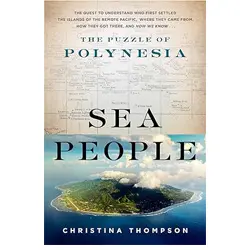
To deepen your knowledge of the art and history of Pacific Island, we recommend the following books:



OUR SERVICES
Customer reviews
Custom order
FAQ
Free shipping
Terms and conditions