





Jewelry and Archaeology of Pre-Hispanic Mexican Cultures
This page is part of our series exploring the history and archaeology of civilizations around the world, with the aim of transforming historical inspirations into jewelry. Here, we set out to discover pre-Hispanic Mexico and its archaeological treasures, which serve as a source of inspiration for our creations.
Mexico and its pre-Hispanic cultures hold a special place in our jewelry collection, due to the richness and diversity of the peoples and traditions that have shaped this land. Our catalog features references to the Aztecs, Olmecs, Mayas, Otomi, Huichol, Zapotec, and Mixtec cultures, to name just a few. These groups have left behind a cultural and artistic legacy of great value, which continues to inspire our work.
The Aztecs, for example, were renowned for their ornaments in gold and turquoise, symbolizing both material wealth and a spiritual connection to the divine. The Mayas, on the other hand, excelled in carving intricate geometric patterns into jade, a sacred material associated with life and regeneration. Each civilization developed its own approach to art and jewelry, reflecting its beliefs, history, and techniques.
The Zapotec and Mixtec cultures, which we are particularly drawn to, originate from the state of Oaxaca, where our workshop is also located. These civilizations were especially renowned for their mastery of metalwork. The Mixtecs, for instance, perfected techniques such as chiseling, creating gold and silver jewelry of remarkable refinement, often adorned with mythological motifs. This artisanal expertise, passed down through generations, is a major source of inspiration for us, and we strive to capture the same delicacy and symbolism in our contemporary creations.
Oaxaca, as a region, is also the birthplace of Monte Albán, a major archaeological site of the Zapotec civilization. This place, with its engravings, stelae, and divine representations, inspires us in the creation of pieces that honor this heritage. The symbols carved in stone and the ritual objects discovered on these lands continue to enrich our creative process.
The Olmecs, the mother culture
The Olmecs are often considered the “mother culture” of Mesoamerica. Emerging around 1500 BC along the Gulf Coast of Mexico, mainly in what are now the states of Veracruz and Tabasco, this civilization marks one of the earliest major stages in the region’s cultural development.
Among their main centers are San Lorenzo, La Venta, and Tres Zapotes, where impressive remains have been uncovered, revealing an already complex social organization. The Olmecs very early on developed artistic and symbolic forms that would have a lasting influence on later civilizations such as the Maya and the Aztecs.
Their art is immediately recognizable, notably through the famous colossal stone heads, but also through a wide variety of objects made of jade, ceramics, and basalt. Their motifs often depict hybrid figures combining human and animal traits, especially the jaguar, a central animal in their worldview, associated with power, fertility, and unseen forces.
Although their writing system and beliefs remain partly mysterious, the Olmecs appear to have laid the foundations for many defining elements of Mesoamerican cultures: a close relationship with the sacred, a worldview structured around natural cycles, and a rich and codified iconography.
Through their forms, symbols, and materials, the Olmecs left a profound legacy, like a cultural matrix whose echoes can be found in the great civilizations that followed.
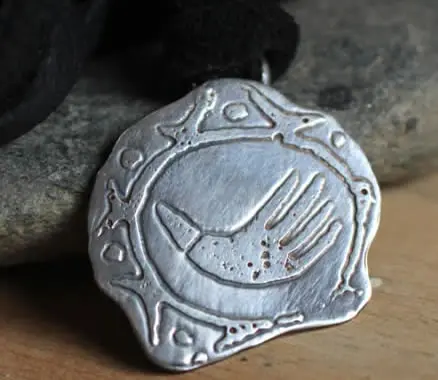
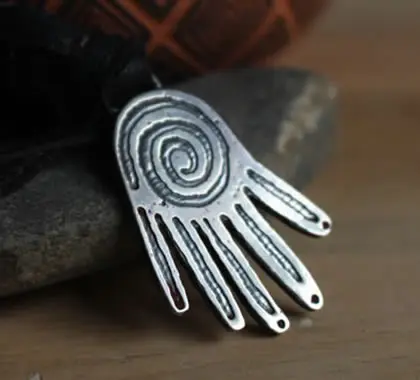
We have also selected two representations of hands from the Olmec civilization. The two pendants, derived from Olmec seals, are named "Olmec hand" and "Creator power." In Pre-Hispanic cultures, the hand is not merely a physical tool but symbolizes creative and divine power, the force that transforms and shapes the world.
In Olmec art, the hand is frequently associated with creative acts and symbols of fertility. This representation establishes a direct connection with the earth and natural elements. The hand motif, engraved in our pendants, evokes skill, and the ability to shape the environment, much like the gods and ancestors revered in Olmec culture.
This symbolism of the hand transcends Mesoamerican boundaries. It appears in many cultures around the world, where it embodies creation, power, and mastery of art. Whether in ancient Egypt, where the hand was linked to the god Ptah, creator of the universe, or in Asian traditions where mudras (sacred gestures) are used to channel spiritual energy, the hand holds a central place in humanity’s symbolic imagination.
The "Olmec Hand" and "Creative Power" pendants we have designed pay tribute to this powerful symbolism. They capture both the ancient tradition and contemporary craftsmanship, offering the wearer an intimate connection with the past and the creative strength that the hand represents.
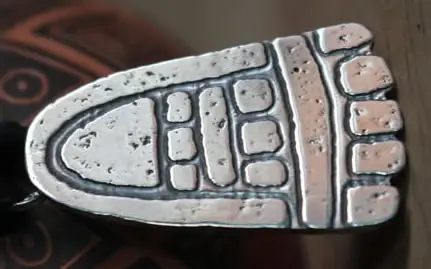
In the same spirit, we have designed a pendant inspired by an Olmec stamp, depicting a foot. This motif evokes movement, symbolizing the transition from one point to another. We named it "Movement," as it portrays one foot interlocked with another, suggesting the idea of successive steps. This pendant embodies the dynamic energy of movement, symbolizing vitality and the constant progression in life.
In Olmec cosmology, movement held significant importance, tied to their understanding of time, space, and natural cycles. The foot, a symbol of progress and connection to the earth, reflected this concept of continuous transformation, where each step represents a new stage in the journey of existence. Movement was not only physical but also spiritual, marking the soul’s path through the various dimensions of life.
This interlocked foot symbol can also be interpreted in a broader context, as in many cultures around the world, the foot is often associated with transition, walking into the unknown, or an intimate connection with nature. It represents grounding in the present while opening the way to the future. This universal symbolism further enriches the meaning of the "Movement" pendant, echoing rites of passage and perpetual evolution.
Meeting the Maya
The Maya civilization developed in Mesoamerica across a vast territory covering southern Mexico (notably the Yucatán Peninsula and Chiapas), as well as Guatemala, Belize, Honduras, and El Salvador. It spans a long chronology, extending roughly from 2000 BC until the arrival of the Spanish in the 16th century, with a particularly flourishing “Classic” period between the 3rd and 9th centuries AD.
The Maya did not form a unified empire, but rather a network of independent city-states such as Tikal, Palenque, and Calakmul, each with its own rulers, alliances, and rivalries. Despite this fragmented organization, they shared a common culture, rooted in a worldview deeply connected to the cycles of time, the movements of celestial bodies, and unseen forces.
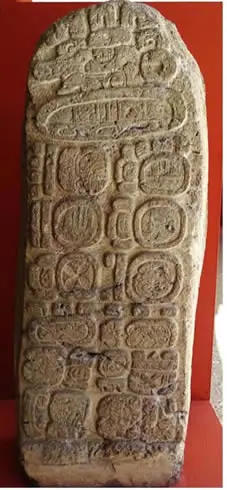
Their relationship with time is one of the most fascinating aspects of their civilization. The Maya developed complex calendrical systems based on the observation of solar, lunar, and planetary cycles. This mastery of time was accompanied by an elaborate hieroglyphic writing system, used to record historical events, rituals, and royal lineages on stelae, monuments, and codices.
Their art is characterized by a rich variety of forms and symbols: stone sculptures, painted ceramics, mural frescoes, and objects made of jade, a particularly precious material associated with life, fertility, and power. Their representations often combine human figures, deities, and animals, within a world where the visible and the spiritual are closely intertwined.
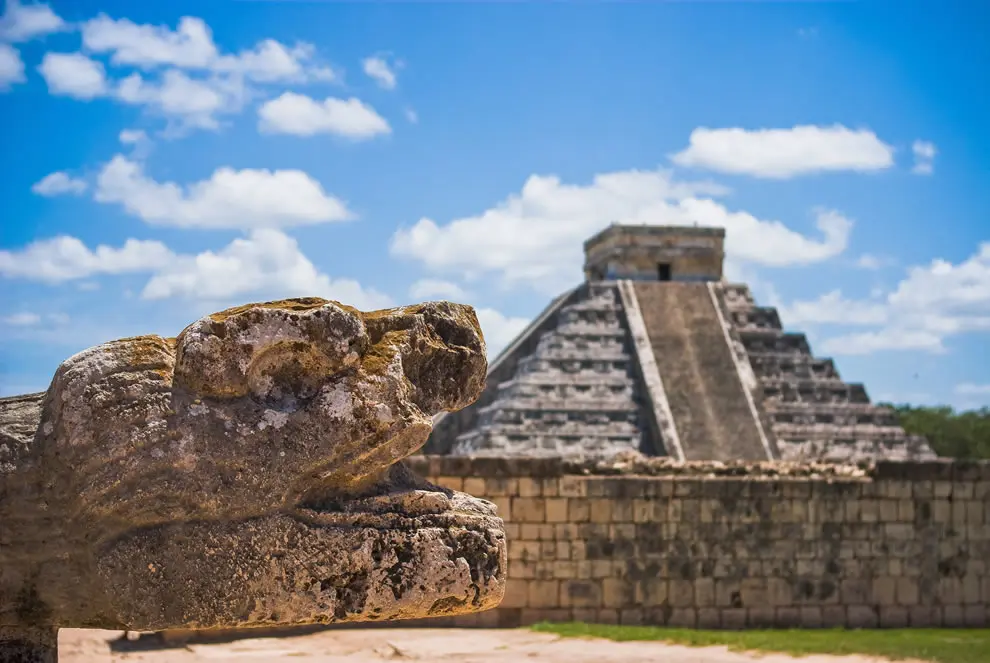
Even today, the remains of Maya cities testify to an impressive mastery of architecture and urban planning, with pyramids, temples, and observatories aligned according to precise astronomical principles. This civilization, both scholarly and deeply symbolic, continues to fascinate through the complexity of its knowledge and the richness of its imagination.
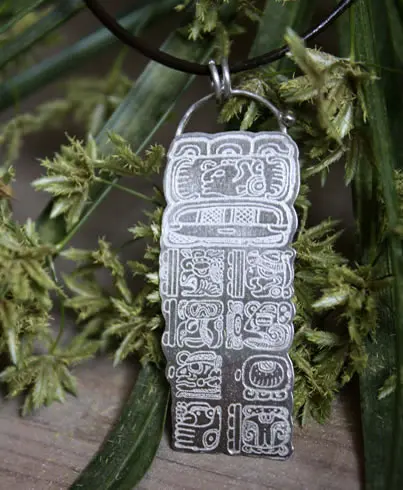
One of the first series of engraved jewelry pieces we created at Emmanuelle Guyon’s workshop is inspired by the Maya calendar. This aesthetically fascinating object is distinguished by the variety of its glyphs, representing each day, month, and year. This technical achievement reflects the precision of the Maya calendar, one of the most sophisticated calendar systems ever developed by humans.
The Maya calendar was not merely a tool for measuring time but played a central role in Maya society. It dictated agricultural cycles, religious ceremonies, and was also used to predict cosmic events. Each cycle held profound spiritual significance, connecting the Maya to their deities and the universe.
To create these jewelry pieces, we had to master the calculation of dates within the Maya system to customize each piece according to the date desired by our clients. The glyphs are not only functional symbols but also tell a visually rich story. Each shape and motif carries meaning: some symbolize deities, elements of nature, or cosmic forces. By engraving these motifs on our jewelry, we aim to capture not only their beauty but also their symbolic depth.
You can find these creations in our store, available as pendants, earrings, brooches, and rings. Each piece embodies a fragment of an ancient civilization, conveyed through timeless symbols. For a more detailed and informative explanation of the Maya calendar, we invite you to visit the following page:
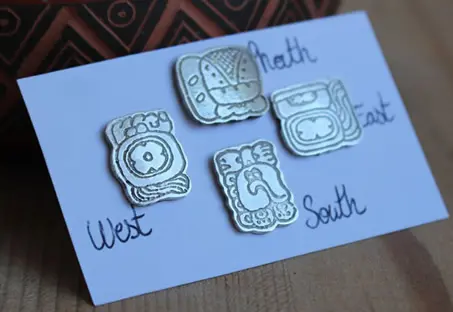
We decided to create earrings by combining different symbolic glyphs important to the Maya. We began with the set named "Maya cardinal points," composed of four pieces representing the glyphs of the four cardinal directions: East (Lak’in), West (Chik’in), South (Nojol), and North (Xaman). These glyphs hold great significance in the Maya culture of Mexico, as they are closely tied to the concept of the cycle and the path of the sun, the primary god of their pantheon, to whom life and the universe are intrinsically connected.
In Maya cosmovision, these four directions are not merely geographical points but pillars of cosmic order. Each cardinal direction is associated with a specific color and divine energy. For example, the East is traditionally linked to the color red, representing birth, dawn, and the energy of renewal, while the West, associated with black, symbolizes the end of the cycle, dusk, and the spirit world. The South is connected to the color yellow, embodying maturity and prosperity, while the North, tied to white, represents ancestral wisdom and the resting place of souls.
These four directions also play a crucial role in Maya rituals, where they are often invoked to balance and harmonize energies during ceremonies, particularly those related to agriculture and natural cycles. Thus, the "Maya Cardinal Points" earrings are not merely decorative pieces but powerful symbols, connecting the wearer to the cosmic order and the eternal cycle of life.
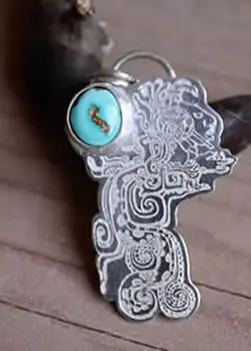
For one of our clients, we designed a pendant representing Kukulkan, one of the major gods of the Maya pantheon, also known as the Feathered Serpent. Kukulkan embodies the power of the four elements — air, earth, water, and fire — and serves as the creator of the universe. A symbol of resurrection and reincarnation, he is closely linked to the cycle of life, death, and rebirth. In Maya civilization, Kukulkan was also the protector of maize, the vital element at the heart of their agriculture and spiritual culture.
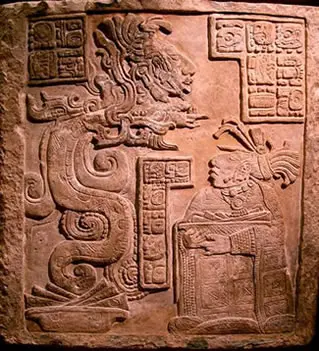
We drew inspiration from Lintel 15 of Structure 22 at the archaeological site of Yaxchilan to represent this god. In this carving, Wak Tuun, the wife of King Bird Jaguar IV, is depicted in a sacred ritual offering her blood to receive a vision of the Vision Serpent, Kukulkan. This blood sacrifice ritual aimed to contact divine spirits and ensure balance between the spiritual and material worlds. Kukulkan, appearing as a winged serpent, acts as a guide between these worlds, symbolizing both wisdom and regeneration.
At the client’s request, we added a turquoise stone to the pendant. In Mesoamerican cultures, turquoise is closely associated with the element of water, essential for the survival of civilizations. A symbol of purity and protection, the stone also evokes the spirit of rain and rivers, further emphasizing the importance of the natural cycle of fertility and abundance, which were fundamental principles for the Maya. This choice highlights the duality between water and maize, perfectly linking nature and the divine in harmonious balance.
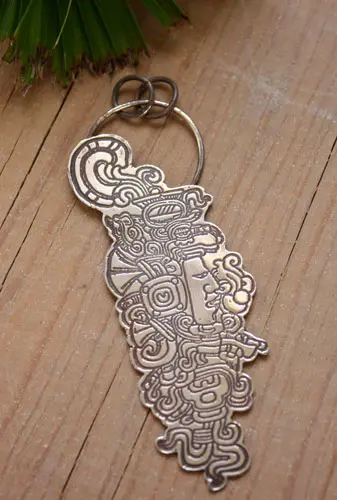
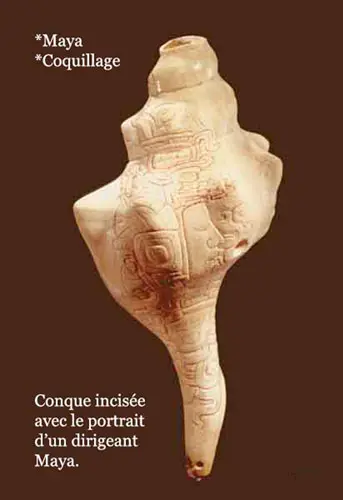
The pendant named "Quiquiztli" is a creation inspired by a sculpted musical conch shell, representing the head of a Maya ruler from the Classic period (250-400 AD). This conch, likely originating from northeastern Guatemala and now housed at the Kimbell Art Museum in Texas, is a rare piece that illustrates the importance of music and ritual in Maya culture. Used in rituals by priests to call for rain and to celebrate military victories, it resonated with solemn power, marking ceremonies with its mystical echo in the sacred landscapes of the time.
The state of Oaxaca: Zapotec and Mixtec
The state of Oaxaca, located in southern Mexico, is one of the great cultural centers of Mesoamerica. A mountainous and diverse region, it has witnessed the development over several millennia of some of the richest and most enduring civilizations of the pre-Hispanic world, notably the Zapotec and the Mixtec.
The Zapotec were among the first to establish a complex society in the region. Their presence is attested as early as the 1st millennium BC, with the emergence of Monte Albán, one of the first major cities in Mesoamerica. Founded around the 5th century BC, this city, perched atop a mountain, became a major political, religious, and cultural center. There, the Zapotec developed a writing system, a calendar, and monumental architecture composed of plazas, temples, and richly decorated tombs. Their worldview, deeply connected to natural cycles and ancestors, is reflected in their funerary practices and ritual objects.
From the 9th century AD onward, as Monte Albán declined, the Mixtec gained influence in the region. Organized into several kingdoms, they are distinguished by their remarkable artistic and craftsmanship skills. Their expertise is especially evident in the working of gold, turquoise, shells, and fine stones, as well as in the creation of richly illustrated codices recording their genealogies, myths, and alliances.
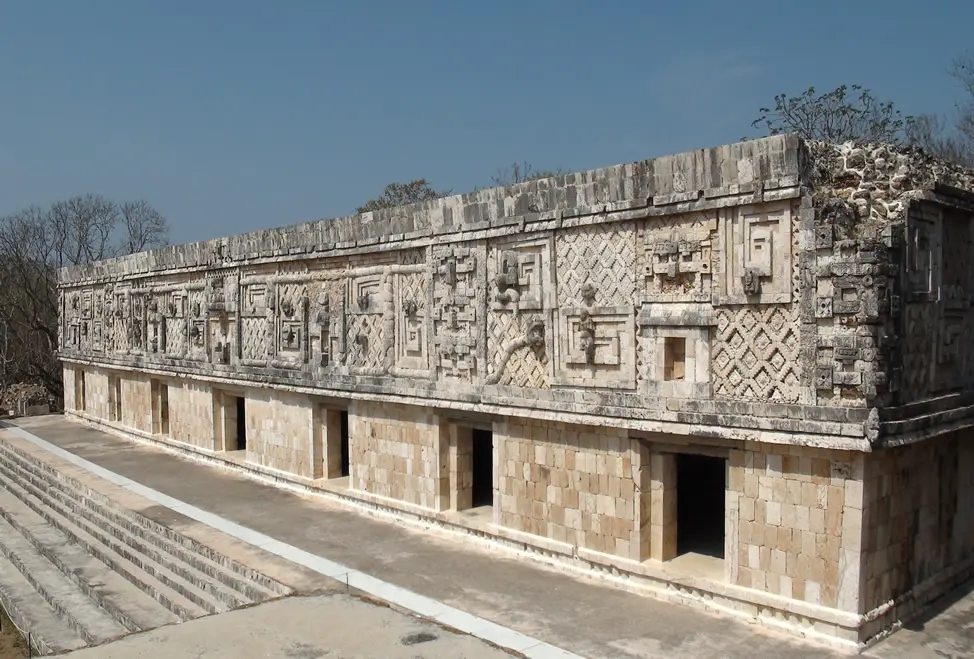
Among their important centers is Mitla, renowned for its geometric stone mosaic decorations of remarkable precision. Unlike large monumental cities, Mitla appears to have served a more ritual and symbolic function, closely linked to the world of the dead and spiritual beliefs.
The Zapotec and Mixtec cultures share a deep relationship with the land, the mountains, and unseen forces. Their works reflect a world in which political power, the sacred, and art are closely intertwined. Through architecture, funerary objects, and precious ornaments, they have left a rich legacy, both aesthetic and symbolic, that continues to inspire and fascinate today.
The remarkable work of the "Mexican grecas", which can be admired at the archaeological site of our neighboring village, Mitla, has profoundly influenced our artistic approach. Mitla, meaning "place of the dead" in Nahuatl, is a sacred site that served as a religious and funerary center for the Mixtec and Zapotec peoples. The intricacy of the mosaics and patterns traced on these works demonstrates exceptional craftsmanship, revealing not only technical skill but also a complex symbolism that remains elusive to researchers.
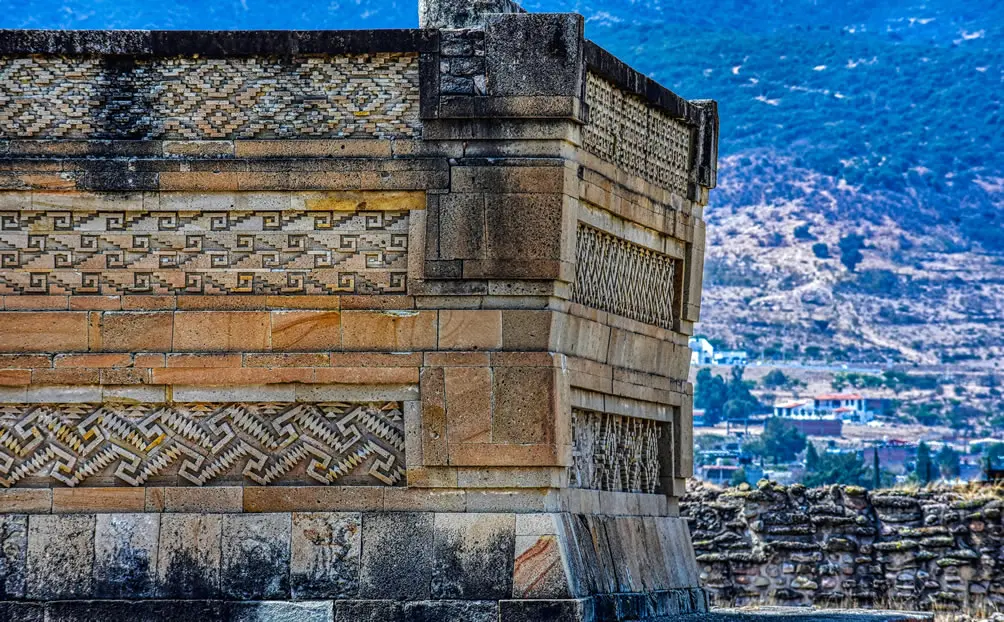
The greca motifs found in many Mexican cultures, offer a wealth of variations and regionalisms that transcend national boundaries. These motifs appear in the architecture of several Pre-Hispanic civilizations, including the Zapotecs, Mayas, and Aztecs. Their rigorous geometry and harmonious repetition are often interpreted as abstract representations of cosmic and spiritual concepts. Their context of use is equally diverse: they can be found on temple facades, noble residences, and even in tombs, symbolizing the continuity between the worlds of the living and the dead.
Despite their omnipresence, there is no universally accepted interpretation of these motifs. Depending on the pattern, they may symbolize the cycle of life, water, eyes, serpents, or the sacred diamond. Some scholars view them as representations of the movement of the earth and stars, or as evocations of spirits guiding the souls of the deceased. The mystical depth of these symbols makes their use in jewelry particularly captivating. Each piece we create, inspired by these Greek motifs, carries an intimate connection with this ancient history.
To illustrate these motifs, we drew inspiration from the treasures of Tomb 7 at Monte Albán, a major archaeological site in Oaxaca, which was the capital of the Zapotec empire until around 800 AD. This site, perched on a hill, demonstrates the architectural ingenuity and cultural significance of this civilization. Several centuries after its abandonment, the Mixtec people buried an important figure there, potentially a female associated with the water cult, as suggested by the funerary objects. This figure was accompanied by the largest treasure ever discovered in Mexico, including numerous gold, jade, turquoise, and shell jewelry pieces, now displayed at the Regional Museum of Oaxaca. Among these treasures are a series of rings that inspired some of our creations.
We designed a ring named "Tesoro zapoteco," paying tribute to the fabulous treasure of Monte Albán. Engraved in silver, this ring features a geometric Zapotec design, both captivating and enigmatic in its deep symbolism. Spirals, a recurring motif in Zapotec art, are often interpreted as representations of the movement of water, essential to life. Staircase representations symbolize the cycle of life and progress toward a higher spiritual plane. This motif is traditionally associated with the image of the serpent, a primordial figure of water and fertility in Zapotec culture.
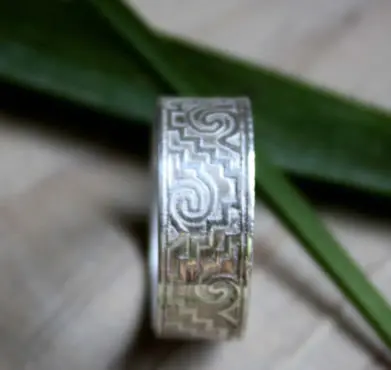
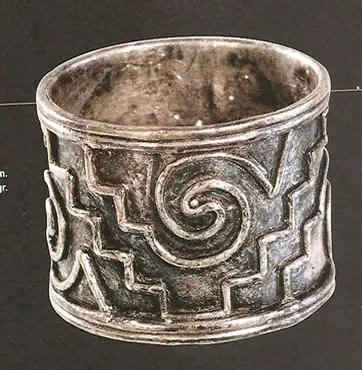
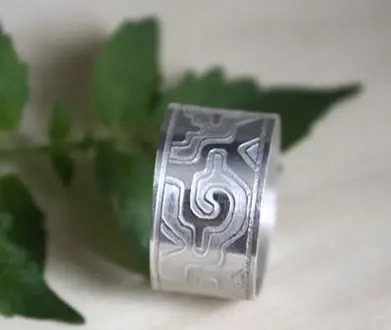
The second ring, inspired by the treasure of Tomb 7, is known as "serpiente de agua" or "water serpent." This motif is also found on the facades of palaces in Teotitlán del Valle and in tombs at Yagul, another significant archaeological site in Oaxaca. It is often compared to eyes formed by the body of a serpent, symbolizing water and the rain god, Cocijo. In Mesoamerican tradition, Cocijo is equivalent to Tlaloc among the Aztecs and Chaac among the Mayas, representing not only agricultural fertility but also the destructive power of storms. This motif, rich in meanings, embodies fertility, regeneration, and the eternal cycle of life and death.
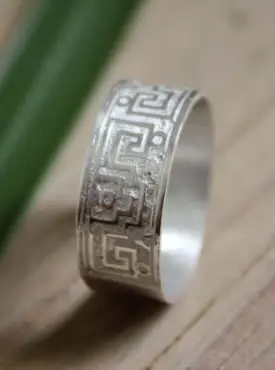
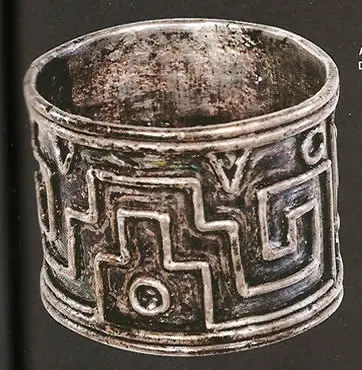
Finally, the third ring in this collection, named "Ga Yixe," takes its name from the goddess "9 herbs," a divine feminine figure associated with fertility and the cycles of nature. The priestesses connected to this cult might have been buried in Tomb 7, given the agricultural and fertility-related ritual objects discovered there. We chose to recreate the ring in a more streamlined version while respecting the original design in gold and silver, to pay homage to the timeless elegance of these ancient jewels.
Meeting the Aztecs
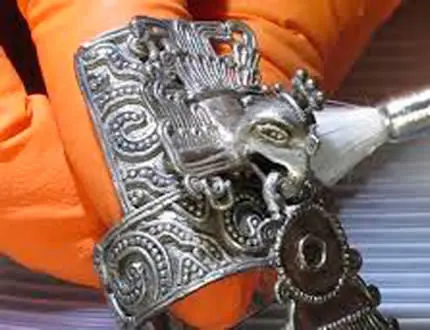
The Aztec civilization, also known as the Mexica, developed in the Valley of Mexico, in central present-day Mexico, and reached its height between the 14th and early 16th centuries. A relatively late people in Mesoamerican history, the Aztecs built their power in just a few generations, establishing a vast empire that dominated much of the central region.
Their capital, Tenochtitlan, was founded in 1325 on an island in Lake Texcoco. This impressive city, organized around canals, causeways, and monumental temples, quickly became one of the most important urban centers of its time. At the heart of the city stood the Templo Mayor, the main religious structure dedicated to the principal deities of the Aztec pantheon.
The Aztecs developed a highly structured society in which political, military, and religious power were closely intertwined. Their worldview was shaped by a complex cosmology based on the fragile balance of the forces of the universe. The gods, the cycles of the sun, and the natural elements played a central role, and rituals, sometimes spectacular, were considered essential to maintaining this balance.
Their art is marked by strong symbolism and remarkable material richness. Aztec artisans excelled in working stone, obsidian, feathers, and especially gold, a material associated with the sun and divine power. The objects they created, whether ritual or ornamental, often combine human figures, animals, and deities in a dense and codified visual language.
The expansion of the empire relied largely on warfare and a tribute system that supplied the capital with wealth and raw materials. This powerful yet demanding organization also contributed to its vulnerability with the arrival of the Spanish in the early 16th century. In 1521, after the fall of Tenochtitlan, the Aztec Empire ceased to exist as a political entity.
Despite this rupture, the Aztec legacy remains deeply rooted in Mexican culture. Through founding myths, powerful symbols, and refined craftsmanship, this civilization continues to fascinate with its intensity, complexity, and rich imagination.
We also designed a series of Mexican pendants inspired by the glyphs and Pre-Hispanic symbols found in stone inscriptions and codices. Each piece is an artistic and symbolic representation of the heritage of this ancient culture, offering a tangible connection to the past.
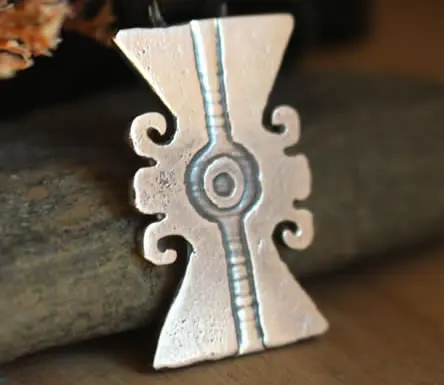
Among these creations, we have developed two distinct pendants based on the Ollin motif, or "movement," a central symbol in Aztec writing and Mesoamerican cosmology. This symbol is rich in meaning, evoking both the constant movement of the universe and the natural cycles that govern the cosmos.
The first pendant, simply named Ollin, represents movement and shaking. It is often associated with the dynamic forces of the Earth, such as earthquakes, and symbolizes perpetual change and evolution. For the Aztecs, this motif embodies transformation and journey, both in physical and spiritual realms. Wearing this pendant reflects the idea that everything is in motion and transformation in the universe.
The second pendant, named Nahui Ollin, carries a more complex significance. This symbol represents the four movements of the sun between the solstices and equinoxes, marking the cycles of sacred time and the importance of cosmic harmony. In Aztec cosmology, Nahui Ollin is also linked to the Fifth Sun, the era in which the Aztecs believed they were living. This Sun was destined to end in earthquakes, reminding us that the balance of the world is fragile and in constant renewal. This motif is drawn from the famous Codex Borbonicus, one of the most important Aztec codices, which provides crucial information on Aztec cosmology, religion, and ritual calendar.
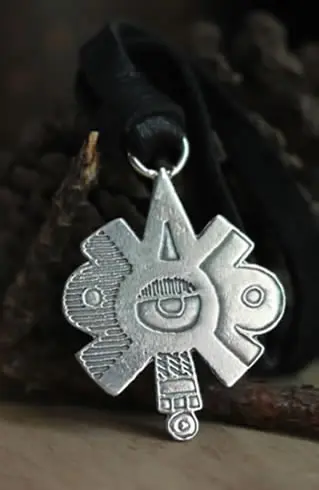
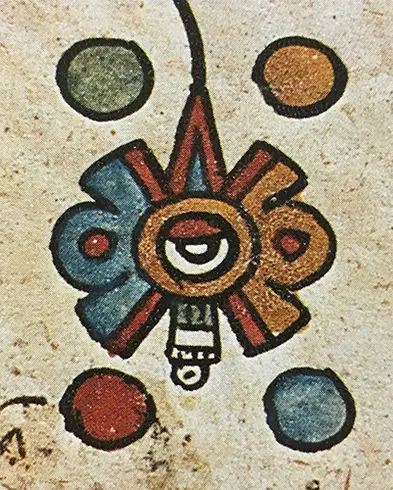
Another glyph we have incorporated is that of the rabbit on the moon, drawn from the famous Codex Borgia, a Mesoamerican manuscript dating back to the 16th century. The origin of this codex is still debated today. It may be of Mixtec or Tlaxcalan origin. However, as its symbols are closer to and more easily interpreted through Aztec references, we have chosen to present it in the section dedicated to this culture.
This symbol is closely associated with the moon goddess, Metztli, who oversees the lunar cycles and the forces of darkness. In Aztec cosmology, the moon plays a fundamental role as the counterpart to the sun, and the image of the rabbit etched on its surface is linked to ancient legends describing how it was projected onto the moon.
According to one legend, the god Quetzalcoatl, traveling in human form, encountered a humble rabbit when he was exhausted and starving. Moved by compassion, the rabbit offered him food. Touched by this gesture, Quetzalcoatl projected the image of the rabbit onto the moon as a token of gratitude, making it immortal in the night sky. This story illustrates both the importance of acts of generosity in Mesoamerican tradition and the rabbit’s recurring role as a lunar symbol.
But it is not only in Mexico that we find stories linking a rabbit to the moon. This motif is also present in other cultures, such as in East Asia, where the rabbit is often depicted preparing an elixir of immortality on the moon. This figure appears in Chinese and Japanese traditions, demonstrating the universality of this symbol. The presence of the rabbit on the moon across various civilizations reveals a deep connection between humans, the cosmos, and the mythological narratives that traverse time and space.
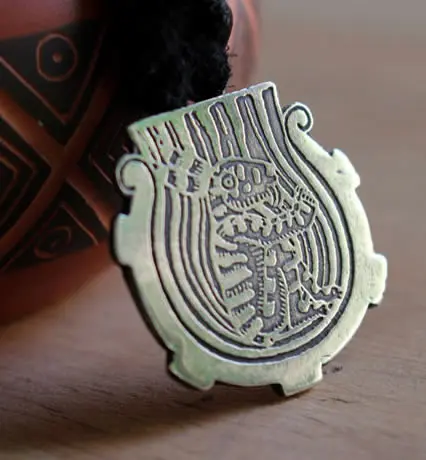
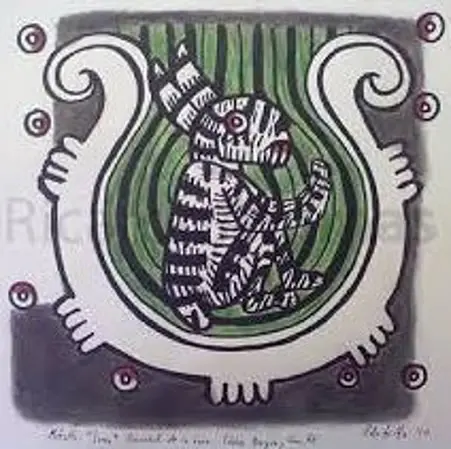
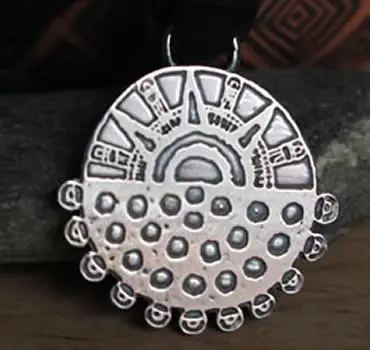
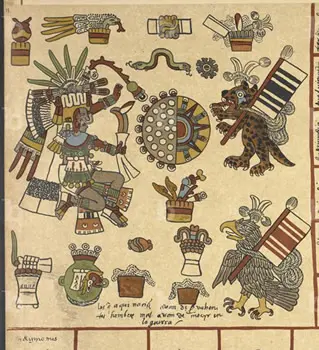
We also selected a glyph for the "Eclipse" pendant. This motif comes from the Codex Borbonicus, a highly significant Aztec document. The glyph, divided into two parts, depicts in the upper section a radiant sun, symbolizing life, warmth, and light. In the lower section, the night is represented, dotted with stars, symbolizing darkness, rest, and mystery. This glyph can be interpreted as an eclipse, a cosmic event both fascinating and feared in many cultures, but it also evokes the perpetual cycle of day and night.
The interpretation of this glyph in the Aztec context reinforces the idea of duality inherent in their worldview: light and darkness, life and death, movement and stillness. These complementary oppositions are at the heart of their cosmology, where day and night, represented by the sun and the moon, are inseparable. The "Eclipse" pendant pays tribute to this interconnection, emphasizing the necessary balance between these opposing forces that govern the universe.
In Aztec tradition, an eclipse was not merely an astronomical event but a sign from the gods, bearing omens and spiritual influences. Eclipses were often linked to rituals aimed at appeasing the deities, and this pendant can also symbolize that sacred connection between the human world and the cosmos.
We also created a pendant replica of an Aztec stone drum, which we named Xochipilli, after the god of music, love, games, beauty, dance, flowers, and poetry, who is depicted on it. This ritual instrument, called a Teponaztli or horizontal drum, was used in ceremonies to accompany dances and songs dedicated to the deities.
The Teponaztli held a central place in Aztec religious rituals. Its sacred sound, resonating through the temples, served to strengthen communication with the gods, fostering a profound spiritual connection. During ceremonies, the rhythm of this drum accompanied the graceful movements of the dancers and the melodies of the songs dedicated to Xochipilli and other deities, creating harmony between humans and the divine.
In addition to being the god of music and the arts, Xochipilli is also associated with divine ecstasy and transcendental joy. The pendant we designed captures this spiritual dimension, evoking the state of rapture and beauty sought during religious rituals. By wearing this pendant, one connects not only to the history of the Aztecs but also to the spirit of celebrating life, love, and art in its purest form.
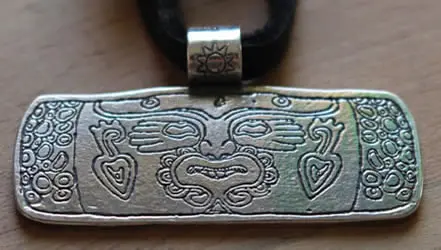
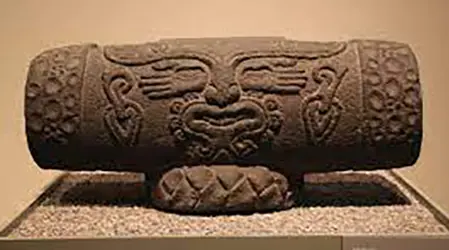
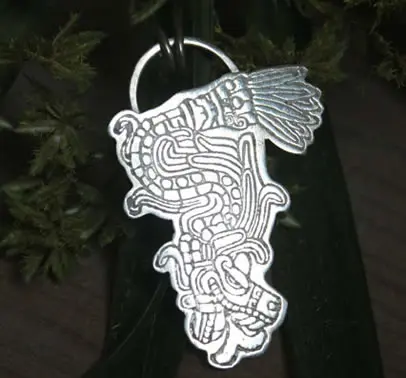
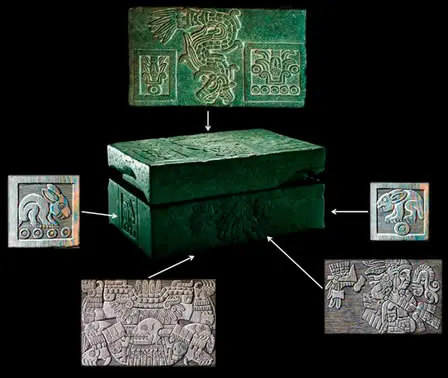
In the same vein, we designed another pendant on the theme of the Feathered Serpent, simply titled "Feathered snake," this time inspired by Aztec culture. This pendant represents the god Quetzalcóatl, a central figure in the Aztec pantheon, symbolizing wisdom, wind, and life. The representation we chose comes from a *tepetlacalli*, a ceremonial stone chest from the Hackmack collection. This type of chest, with its lid engraved with the image of Quetzalcóatl, dates back to the period between 1502 and 1520 A.D., just before the fall of the Aztec empire.
*Tepetlacalli* were often used to store sacred objects, ritual offerings, or even the ashes of deceased rulers. The choice of Quetzalcóatl on this particular piece highlights the spiritual and political significance of this god for the Aztec elites. As a deity associated with the creation of the world and the connection between humans and the divine, Quetzalcóatl symbolizes the cycle of life, death, and rebirth.
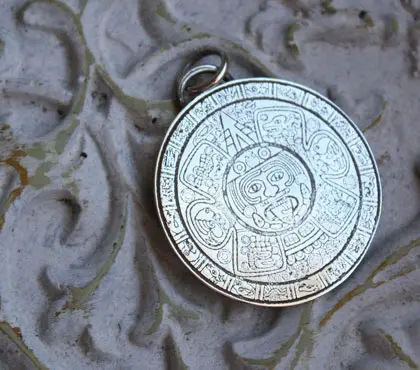
The pendant we named "Mesoamerica" is a custom piece, created in response to the specific desires of our client. While this motif is often featured in jewelry inspired by Mesoamerican culture, we added personalized glyphs on the back to give it a unique touch.
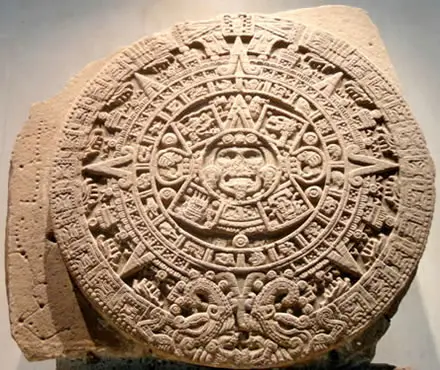
The main design of this pendant is inspired by the central portion of the Aztec Sun Stone, also known as the Aztec Calendar. This monumental stone, housed at the National Museum of Anthropology in Mexico City, dates back to 1479 and likely served as a *Cuauhxicalli*, a receptacle and altar for sacrifice. For our interpretation, we chose to depict only the innermost circles of the calendar.
The first circle features a hybrid head combining the sun god Tonatiuh and the earth goddess Tlaltecuhtli, symbolizing the union of sky and earth. The second circle displays symbols representing the gods Ehecatl, Texcatlipoca, Tlaloc, and Chalchiuhtlicue, echoing the legend of the Four Suns, an Aztec cosmogony describing the stages of world creation. Lastly, the outer circle of the pendant shows the 20 day glyphs of the month, offering a complete view of the calendrical system and the concept of time in Mesoamerican tradition.
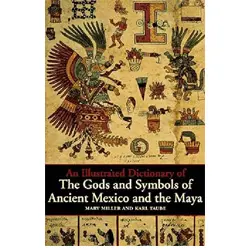
To deepen your knowledge of the art and history of mexican culture, we recommend the following books:



OUR SERVICES
Customer reviews
Custom order
FAQ
Free shipping
Terms and conditions