








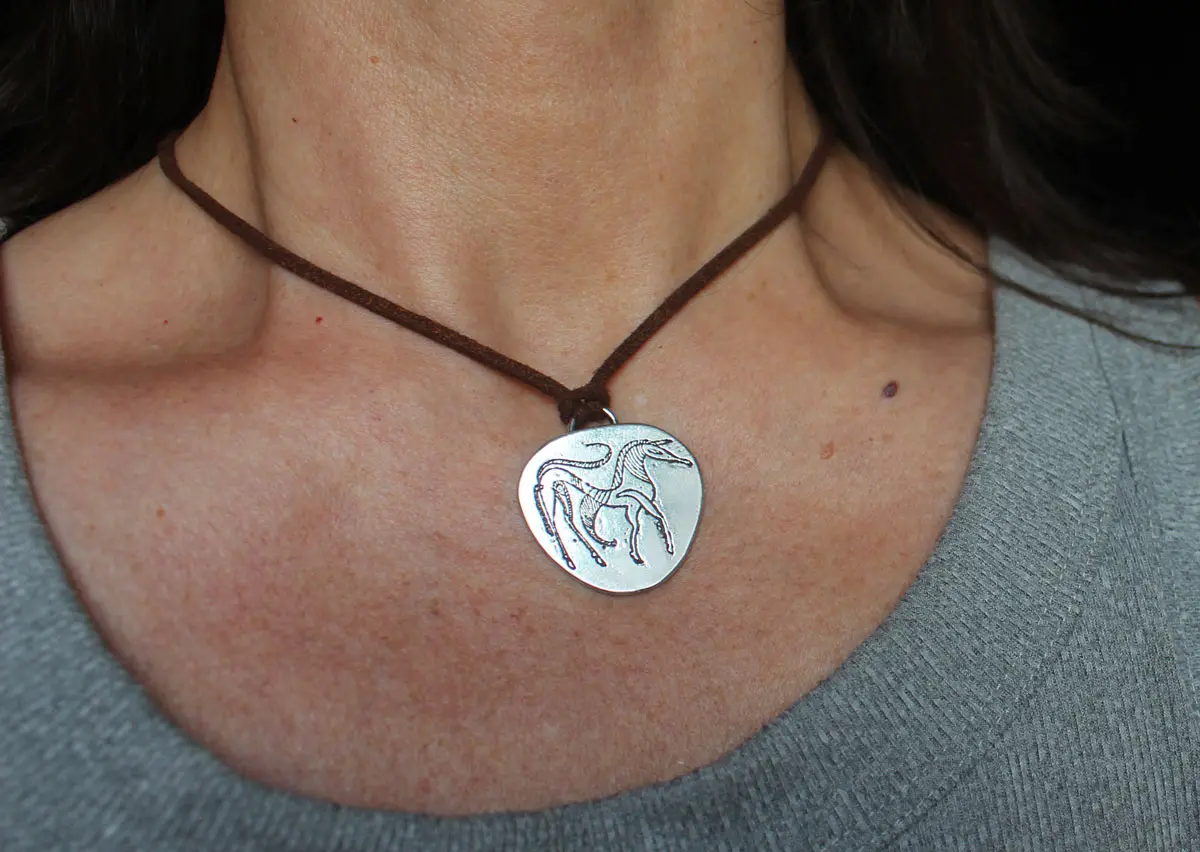





Soul guide, Faliscan horse and serpent pendant in silver
Our creation takes you today to ancient Italy, to discover the Faliscan people and their ceramic art. The horse motif engraved on this silver pendant comes from a funerary ceramic amphora produced by the Faliscans, an Italic people who lived north of Rome between 650 and 600 BC, in what is now the Lazio region, around Civita Castellana, ancient Falerii.
Closely connected culturally to the Etruscans, the Faliscans had their own identity and artistic traditions. They are particularly known for their production of pottery known as Faliscan impasto. This ancient technique involves working with clay whose texture is relatively coarse, often dark and sometimes given a polished sheen. Potters shaped their vessels by hand or on a wheel, then decorated their surfaces in various ways, including incision, a technique in which the clay is directly engraved while still fresh using a pointed tool.
Faliscan workshops became particularly specialized in this type of impasto pottery, featuring very fine engraved decorations. Their artisans favored depictions of animals, sometimes fantastical, with elongated silhouettes, as well as palmettes and geometric patterns inspired by Eastern art. The incisions created contrasts against the dark, polished surface of the pottery, giving depth to the designs without the need for many colors. These decorations demonstrate a genuine level of craftsmanship. Figurative representations are, in fact, relatively rare in certain types of Faliscan incised impasto pottery.
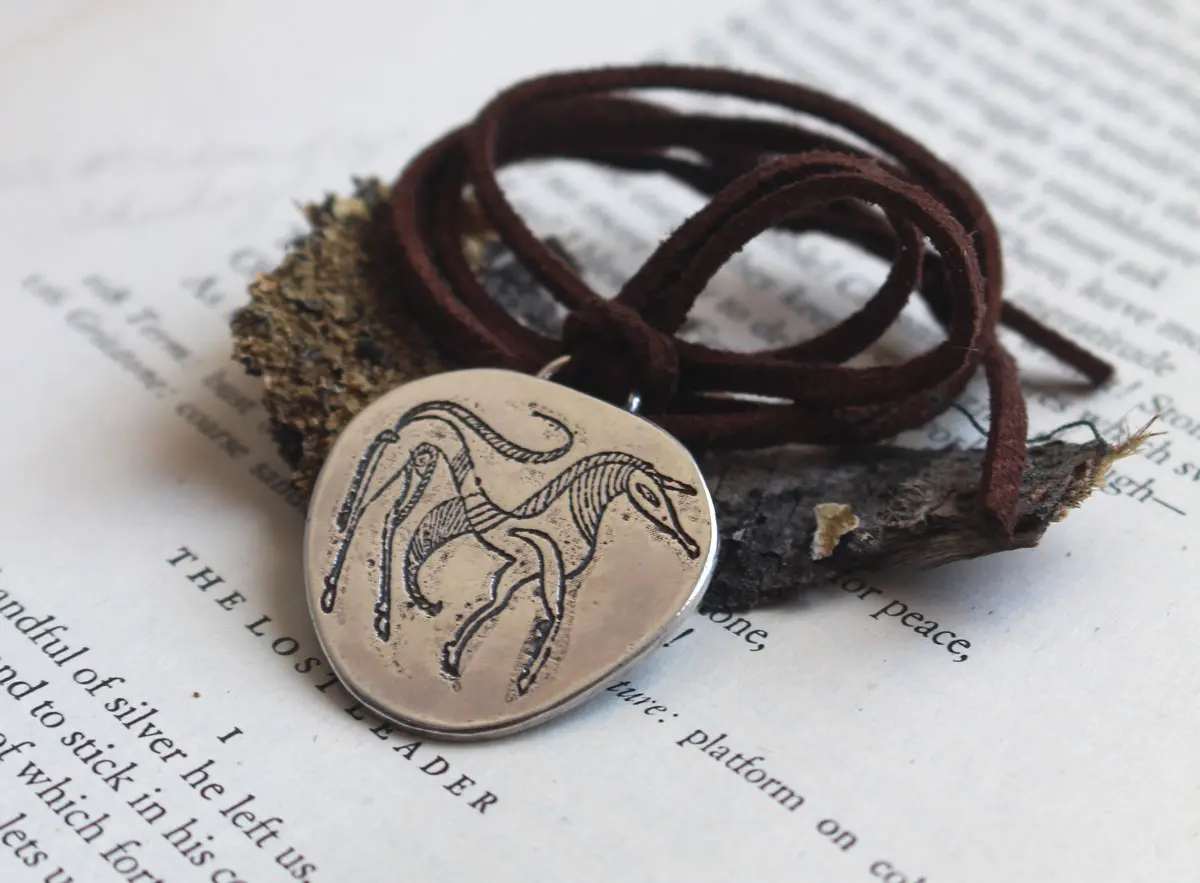
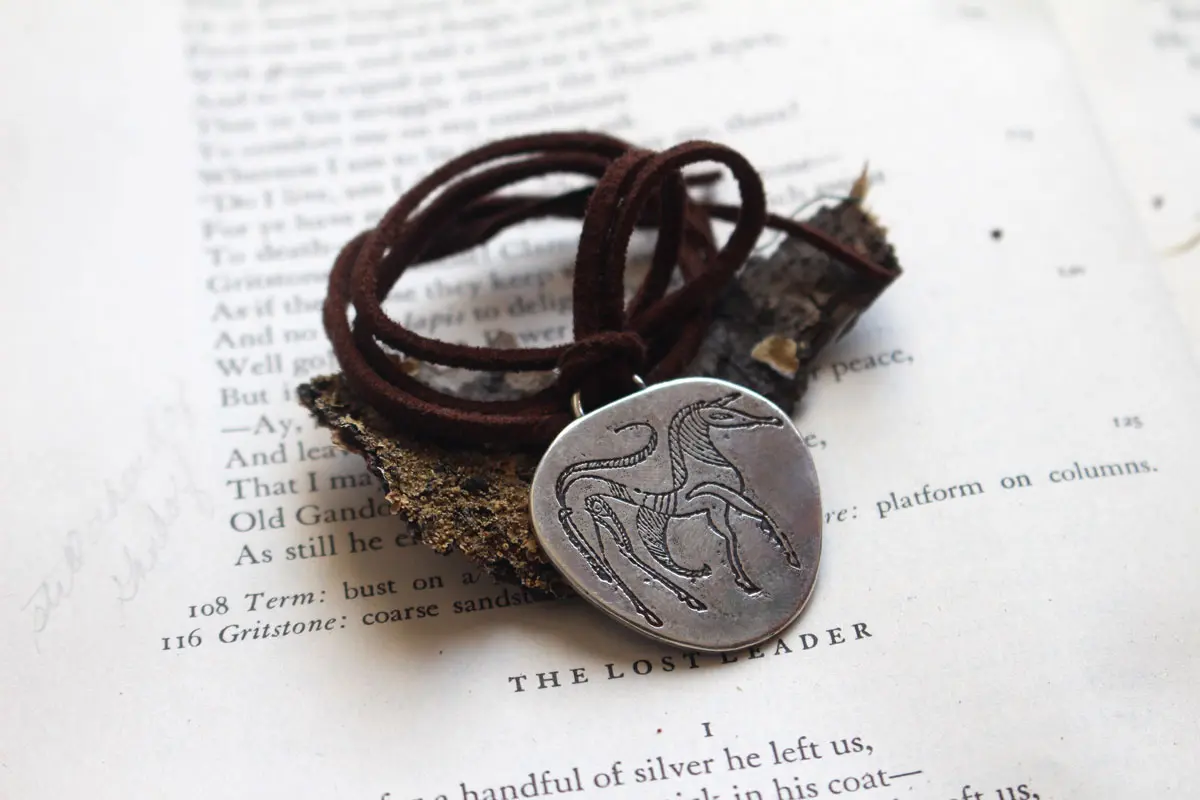
On this particular funerary amphora, we can admire the engraving of a hybrid animal, somewhere between a horse and a serpent. The motif visible on the body of the amphora belongs to the Orientalizing period, generally dated in central Italy from the late 8th to the 6th century BC. This period was marked by commercial and cultural exchanges with the peoples of the eastern Mediterranean, particularly the Phoenicians, Greeks, and civilizations of the Near East. Italic and Etruscan artisans drew inspiration from these influences to develop a rich decorative vocabulary featuring fantastical animals, hybrid creatures, and plant motifs.
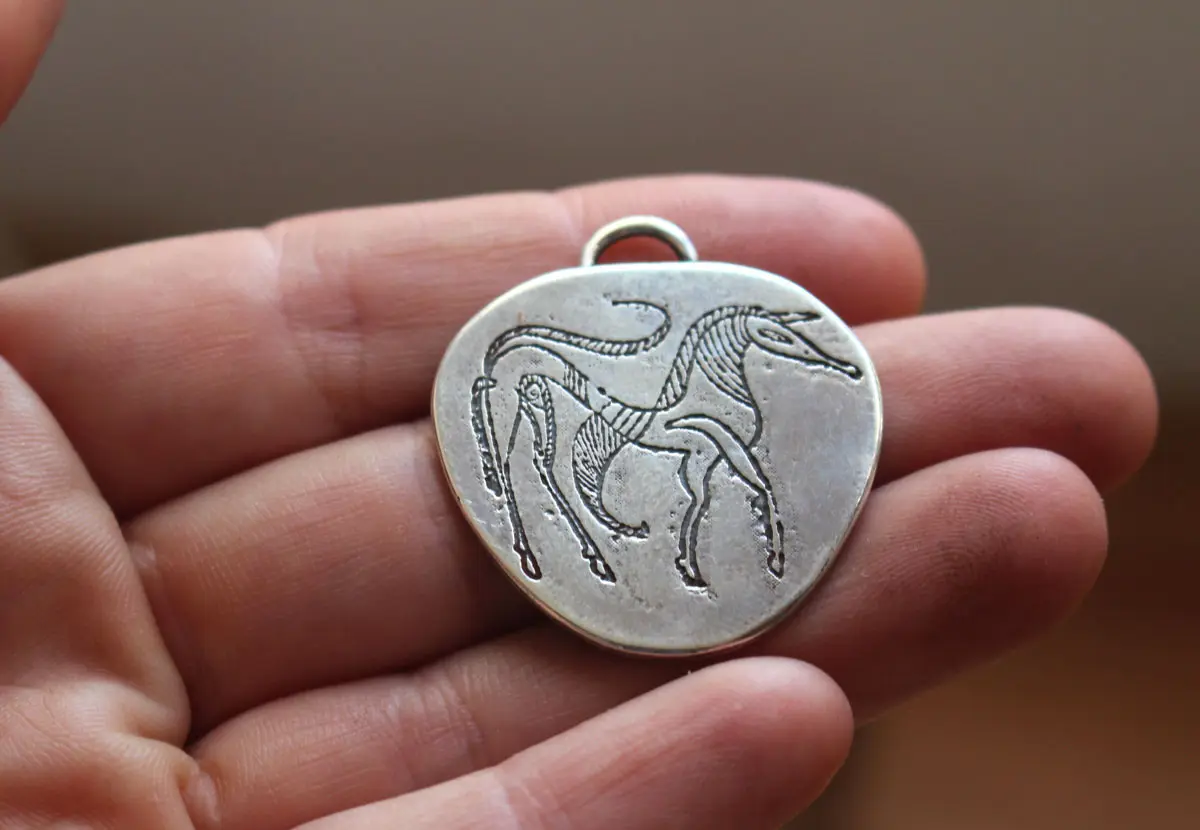
The animal's body is strongly elongated, with a prominent chest, a high rump, and slender limbs formed by continuous, taut lines. This preference for elongated and graceful animal silhouettes is characteristic of Orientalizing art. The neck, back, tail, and certain shaded areas are decorated with series of parallel lines and engraved hatching. This technique gives rhythm and volume to the representation while emphasizing the different parts of the body without the use of color.
We can also distinguish an elongated muzzle, a clearly defined almond-shaped eye, and an ear, horn, or raised appendage that gives the silhouette a sense of movement toward the right. The unusual proportions of this animal make its identification uncertain: is it a stylized horse, an unusually slender stallion, or a fantastical creature? Looking at the animal's back and hindquarters, we notice a serpentine tail, or a sinuous appendage, as well as hatched patterns that may suggest curved wings or feathers. These details enhance its mysterious character and recall the taste of Orientalizing artisans for imaginary animals and hybrid creatures.
At that time, the horse was above all a symbol of social prestige and wealth. Breeding and maintaining horses required considerable resources, meaning that only part of the population, particularly aristocratic families, could afford to own them. This noble animal was therefore closely associated with the elite, travel, warfare, and heroic or aristocratic representation. The horse could also symbolize power, courage, victory, and its owner's social standing.
In the funerary context of ancient Italy, the horse also had a symbolic dimension associated with death and the passage into the afterlife. Its representation in tombs and on funerary objects could evoke the deceased's journey to the world of the dead. In certain traditions and religious interpretations, the horse is considered a psychopomp animal, meaning a spiritual guide capable of accompanying the soul of the deceased from one world to another. Its presence on a funerary amphora could therefore be associated with the idea of a journey into the afterlife, worthy of the deceased's status and prestige.
By adding wings or marine attributes, such as a serpent's or fish's tail, artisans could give the animal a supernatural dimension. It was no longer simply a horse belonging to the earthly world, but an imaginary creature capable of crossing the boundaries between different worlds. The fantastical animals and hybrid creatures found in the Orientalizing decorative repertoire could also be associated with protective forces and the fight against evil influences. They thus formed part of the religious and funerary imagery surrounding the tomb and the deceased.
Finally, owning funerary objects decorated with this complex mythological bestiary was also a sign of the family's wealth and its access to Mediterranean cultural exchanges. Such objects could express membership in a warrior and aristocratic elite, for whom the horse represented the noblest of animals.
With this silver pendant, we wanted to bring this strange animal from ancient Italy back to life. Between horse and serpent, between the earthly world and the fantastical realm, the motif evokes passage, travel, and transformation. A creation inspired by Faliscan art and the mysterious funerary beliefs of the peoples of ancient Italy.
Metal: 925 sterling silver.
Dimensions: 1.18 x 1.30 in (3 x 3.3 cm).
A 35.43 in (90 cm) vegan suede cord is included with the pendant.
Production time: 5 business days before your order is shipped.
Each handcrafted piece of jewelry is entirely designed and made by hand, without the use of computer-aided design (CAD), digital laser cutting or engraving, or 3D printing.
As we are based in Mexico, please allow 3 to 6 weeks for delivery to receive your order for free with standard postal service. Thank you for taking this information into account before ordering in our shop. At checkout, you will also have the option of choosing an express shipping. (please read the full shipping terms here).
You have a question? Contact us.
I hope you will love this jewel as much as I enjoyed creating it.
By Emmanuelle Guyon.
Tags: Romans, horse, archaeology, amphora, archaeological reproduction, symbol, funerary, psychopomp animal, animal, serpent, guide, Faliscan, Etruscan, antiquity, fantastical, soul guide, journey, soul, Italy, Italian, mythology, legend
Inspired by your search: horse, pendant, serpent, guide
OUR SERVICES
Customer reviews
Custom order
FAQ
Free shipping
Terms and conditions