




Prehnite: history, healing properties and lithotherapy
Prehnite properties
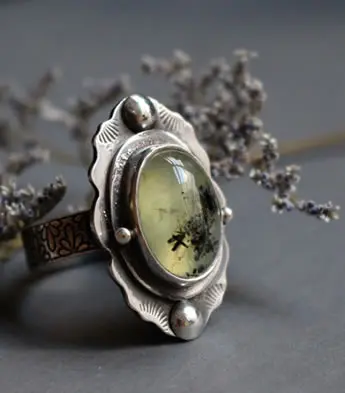
Its name, prehnite, was given by Abraham Gottlob Werner in 1813 in honor of the Dutch commander Hendrik von Prehn, whom he believed to be the discoverer of this mineral. However, historical records suggest a different reality: the earliest description of this stone dates back to 1771 by Balthazar Georges Sage, who named it "Chrysolite of the Cape." Thus, prehnite stands out as one of the first minerals to be named after a person.
Prehnite belongs to the silicate group, specifically a calcium aluminium phyllosilicate. Its chemical composition is Ca₂Al(AlSi₃O₁₀)(OH)₂, with calcium and aluminum as its primary constituents. However, a fraction of the aluminum can be replaced by iron (up to 7%), which can slightly alter its hue. It crystallizes in the orthorhombic system and primarily forms in the veins and cavities of basalts and low-temperature metamorphic rocks. It is often found in association with minerals such as stilbite, epidote, calcite, and zeolites, which explains its frequent association with volcanic and hydrothermal environments.
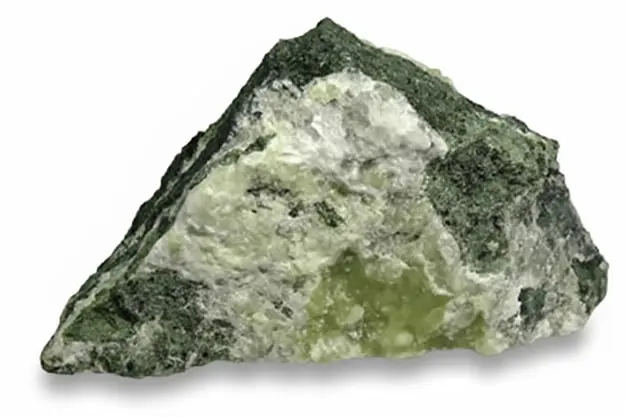
Prehnite typically displays a color range from green to yellow, offering translucency that gives its reflections a subtle and mysterious aura. Sometimes, its resemblance to jade is so striking that it can sometimes be used as a substitute for it. Recently, a rare variety with an orange hue has been discovered in South Africa and Canada, further expanding the fascinating diversity of this gem.
Its distinctive structure often manifests as compact masses adorned with radiating fibrous spheroids, sometimes accompanied by tabular crystals emerging in striking crests. In addition to this massive structure, prehnite can also appear in botryoidal form, in compact layers, or in stalactites. Well-formed crystals are rare but spectacular when they appear in geodes.
Physically, prehnite has a hardness of 6 to 6.5 on the Mohs scale, making it relatively durable, although softer than quartz. Its fracture is generally conchoidal to irregular, and its luster ranges from vitreous to pearly. Its refractive index varies between 1.611 and 1.669, giving it a particular brilliance depending on its size and polishing. Some prehnites even exhibit a faint fluorescence under UV light, usually in pale green or white tones.
Prehnite is extracted in many countries around the world. The most famous deposits are found in South Africa, particularly in the Cape region, where well-formed crystals with intense colors are found. Other notable sources include Australia, China, the United States, Scotland, India, and France, notably in Auvergne and Brittany.
Due to its color and texture, prehnite is often confused with other minerals. It can resemble jade (nephrite or jadeite), serpentine, chrysoprase, or even green smithsonite. However, its hardness and fibrous or granular structure allow it to be distinguished under careful examination.
It is known by a variety of names, reflecting its diversity and presence in different regions of the world. It is sometimes called Adelite, Aedelite, Bostrichite, Chiltonite, Chrysolite of the Cape, Coupholite, Prehnitoid, radiated schorl, Copper Zeolite, or Sparkling Zeolite. In South Africa, it is sometimes referred to as the Emerald of the Cape, while in China, it is known as "grape jade" (Putao Yu), highlighting its popularity and significance in the culture and geological history of these regions.
Main deposits: South Africa, France, the United States, India, Italy, Switzerland, Germany and Spain.
History, legends and beliefs about prehnite
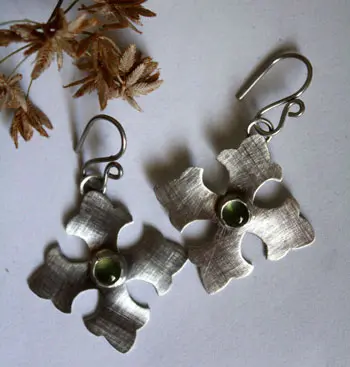
Prehnite was revered by the Aboriginal people of Australia, who believed in its unique power to absorb and retain the energy of the sun. According to their ancestral belief, this energy was released during the night, providing warmth and protection against the mysterious creatures of the dark. Thus, prehnite was more than just a stone for them: it was a vital link to the forces of nature and a benevolent guardian of the Australian nights.
In South Africa, prehnite held a special place in shamanic practices, where shamans considered it a valuable tool to facilitate wise and enlightened decision-making for the benefit of the entire community. They believed that prehnite possessed innate wisdom, acting as a spiritual guide to illuminate the path toward just and harmonious choices, thereby strengthening the bond between individuals and their community.
In China, prehnite was sometimes associated with jade due to its color and translucent appearance, giving it a symbolic connection to longevity, prosperity, and spiritual harmony. Known as "grape jade" (Putao Yu), it was valued for its visual softness and its supposed ability to promote meditation and inner wisdom.
In Celtic tradition, although poorly documented, some sources suggest that prehnite may have been used by druids as a stone to connect with natural forces and the spirits of the forest. It was seen as a stone of premonition and clairvoyance, capable of opening the mind to prophetic visions and dreams.
Finally, during the 19th century, prehnite experienced a resurgence of interest in the world of mineralogy, thanks to the rise of private collections and curiosity cabinets in Europe. Its fascinating structure and resemblance to certain gemstones sparked the interest of gemologists and explorers, contributing to its spread in various modern esoteric traditions.
Healing properties and benefits of prehnite
Over the centuries, various civilizations have attributed to prehnite a rich symbolism and a variety of properties. The observations presented here are offered from a cultural and historical perspective, aiming to illustrate the connections this stone may have held with human experience and traditional practices. They do not constitute medical or therapeutic advice, nor personal recommendations, but reflect the uses and interpretations found across different traditions.
- Prehnite has been associated with beneficial effects on the skin, such as acne or local inflammations. It is often described as providing support in soothing imbalances and promoting a more even and balanced complexion. Some sources also highlight its possible role in regulating hormonal processes that can influence skin health.
- Regarding respiratory issues, particularly asthma or allergic reactions, prehnite has traditionally been considered a stone that accompanies the easing of lung tension and helps maintain smoother, more regular breathing.
- It has also been linked to digestion and the gastrointestinal system. It is believed to support the reduction of gastric acidity, alleviate certain digestive discomforts, and assist natural detoxification processes.
- Historically, prehnite has been associated with the relief of chronic pain, whether located in the lower back, shoulders, or abdominal and thoracic areas. Its crystalline structure and presence in mineral traditions make it a stone often connected to the alleviation of physical tension.
- It is mentioned in traditional contexts as supporting kidney health and circulation, as well as aiding the elimination of toxins. Some accounts also suggest a potential role in regulating conditions related to uric acid, such as gout, or in general support for the circulatory system.
- Valued for its gentle appearance and calming presence, prehnite is often described as promoting inner calm and serenity, particularly in situations of stress or anxiety.
- It is also associated with mental clarity and organizational capacity. Certain traditions present it as an aid for structuring thoughts, enhancing concentration, and dispelling feelings of confusion or mental fatigue.
- Prehnite has been used to support sleep: placed near the pillow, it is believed to help create an environment of safety and tranquility, contributing to more regular and restful sleep cycles.
- Some texts and accounts describe it as a stone of refined perception or foresight, valued for its role in opening the mind to intuition and sensitivity to subtle impressions. It is thus associated with meditation, introspection, and attention to personal experiences.
- Within the framework of traditional energetic practices, prehnite is considered a gentle protective stone. It is said to support the purification and strengthening of the personal energy field, while limiting the influence of disruptive vibrations or energies, particularly for those sensitive to the emotions of others.
- Finally, prehnite is often connected to nature and natural cycles. It is seen as a stone that fosters connection with the elements, reinforcing the bond with the plant and mineral world, and supporting those seeking to harmonize their relationship with the environment or channel benevolent natural forces. Some sources also attribute to it qualities of emotional support, stability, and symbolic guidance, further enriching its reputation as a versatile stone throughout the history of human cultures.



 Please note that all healing properties attributed to stones come from ancient traditions and various cultural sources. This information is provided for informational purposes only and does not constitute medical advice. In case of any health concerns, it is recommended to consult a qualified professional.
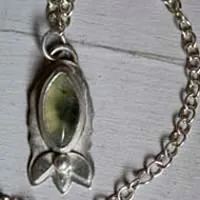
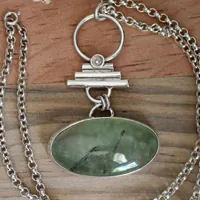
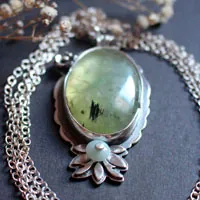
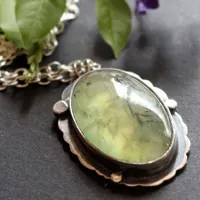
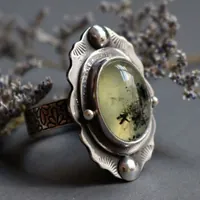
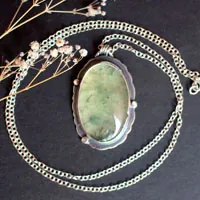
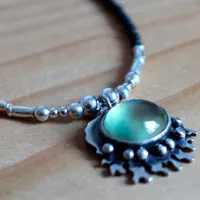
Prehnite jewelry samples
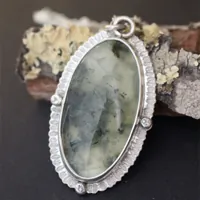
186.00 €
(≈ 215.76 USD)

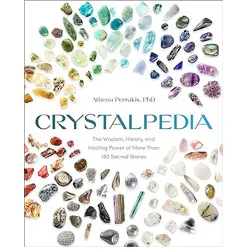
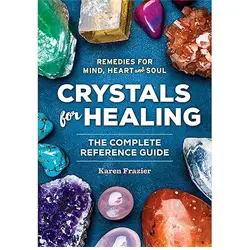
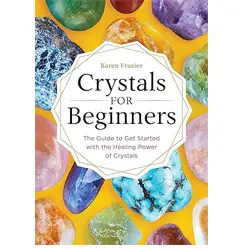
To learn more about litotherapy, we recommend you the following books:
OUR SERVICES
Customer reviews
Custom order
FAQ
Free shipping
Terms and conditions