






Green tourmaline or Verdelite: history, healing properties and lithotherapy
Green tourmaline properties
The tourmaline family is a group of complex minerals with a highly variable chemical composition, resulting in a wide range of colors and varieties. Each type of tourmaline is identified either by a specific name or by the term "tourmaline" followed by the stone’s dominant color.
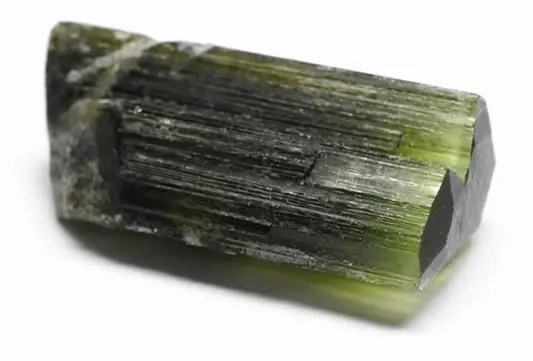
Green tourmaline, often called Verdelite, stands out with its shades ranging from pale green to deep green, including olive, emerald, and bottle-green tones. Its color is primarily due to the presence of iron and titanium, although some more intense varieties are colored by chromium or vanadium, giving them a more vibrant saturation and a visual resemblance to emeralds.
Varieties of green tourmaline include:
- The classic Verdelite: This variety includes most green tourmalines, with shades ranging from light to dark green, often translucent to transparent.
- Chrome-bearing tourmaline: A rare and valuable variety where the intense color is due to the presence of chromium and vanadium, giving it a hue similar to the finest emeralds. This variety is mainly mined in Brazil and East Africa.
- Green dravite tourmaline: Less common, it has a green-brown or olive-green hue with lower transparency due to a high magnesium content.
- Watermelon tourmaline: A bicolored tourmaline that combines green and pink within the same crystal, creating a highly sought-after aesthetic contrast.
The resemblance between green tourmaline and emerald has led to many historical confusions. This misunderstanding is particularly frequent for chrome-bearing tourmalines, whose color rivals that of the finest emeralds from Colombia or Zambia.
A famous example of this confusion dates back to the Spanish colonial era when conquistadors discovered magnificent green stones in Brazil. Believing they had found a new emerald deposit, they exported them to Europe, where they were set in prestigious jewelry. It was only centuries later, thanks to advances in gemology, that some of these "emeralds" were identified as green tourmalines.
Famous examples of green tourmaline jewelry include:
- The emerald and diamond necklace of the Duchess of Windsor: This famous piece, auctioned at Sotheby’s in 1987, was believed to contain 27 Colombian emeralds surrounded by diamonds. After a thorough analysis, it was revealed that these stones were actually green tourmalines, a discovery that generated great interest in the jewelry world.
- The emerald and diamond tiara of the Swedish royal family: This tiara, worn by Queen Silvia of Sweden, was once considered to be adorned with genuine emeralds. However, modern gemological analyses revealed that these stones were in fact green tourmalines, once again demonstrating the ability of this gemstone to rival the finest emeralds.
Due to its beauty and brilliance, green tourmaline is now a popular alternative to emeralds, offering a more affordable option while maintaining an impressive visual quality. Its hardness, ranging from 7 to 7.5 on the Mohs scale, makes it suitable for durable everyday jewelry.
Main deposits: Brazil, Afghanistan, Pakistan, the United States, Sri Lanka, Russia, Angola, Australia, Burma, India, Italy, and Tanzania.
History, legends, and beliefs about green tourmaline
Green tourmaline, or Verdelite, has been known since antiquity, though it was long mistaken for other gemstones, particularly emerald. While tourmaline was used well before it was scientifically identified, it was only recognized as a distinct mineral species in the early 18th century.
Some theories suggest that green tourmaline was already recognized in ancient Egypt. The Egyptians believed that this stone was born from the heart of the Earth and had traveled through a rainbow on its way to the surface, explaining the diversity of its colors. This legend applies to all tourmalines but holds particular significance for Verdelite, which was associated with fertility, renewal, and heart protection. Green stones have been found in some Egyptian tombs, though their exact nature is not always identifiable. It is possible that some of these stones were tourmalines, regarded as bearers of protective and abundant energy.
In China and India, green tourmaline has long been linked to energy balance and well-being. Traditional Chinese medicine attributes to it properties that harmonize the flow of qi (vital energy), while in India, it is sometimes associated with the heart chakra (Anahata), fostering love, compassion, and vitality. In some regions of Asia, green tourmalines were set into amulets and used as talismans to attract prosperity and ward off illness. They were also incorporated into imperial seals and court jewelry, especially during the Qing dynasty in China.
In South America, where numerous green tourmaline deposits are found, indigenous peoples viewed this stone as a link between the Earth and spiritual forces. Among certain Amazonian tribes, Verdelite was used by shamans to channel the energies of nature, purify the soul, and strengthen connections with forest spirits.
Among Native American tribes of North America, green tourmaline was sometimes considered a stone of regeneration. Healers wore it to restore vital energy and promote the healing of both physical and emotional wounds.
Since the Renaissance, green tourmaline has been set into prestigious jewelry and included in the collections of European royal families. Its resemblance to emerald made it a valuable alternative, often chosen to adorn tiaras, brooches, and ceremonial necklaces.
Healing properties and benefits of the green tourmaline or Verdelite
Throughout the long history of humanity, various societies have attributed to green tourmaline, also known as Verdelite, a range of properties, virtues, and interpretations of a symbolic or curative nature. The elements presented here are framed within a cultural, historical, and descriptive approach, aiming to illustrate the symbolic relationship that has gradually developed between this stone and human civilizations over the centuries. As with the previous examples, this information is based on a scientific and historical perspective. It does not constitute medical or therapeutic advice, nor does it reflect personal beliefs.
- Green tourmaline has traditionally been associated with the body’s natural defenses. According to certain traditions, it is linked to enhanced resistance to external influences and to an overall strengthening of bodily vitality.
- It is frequently mentioned in relation to the venous and lymphatic systems. Symbolically, it is associated with a more harmonious flow of fluids, which has led to its connection with the prevention of conditions such as varicose veins or the sensation of heavy legs.
- Some ancient beliefs attribute to green tourmaline a role in supporting blood imbalances, such as anemia or intoxications. In this context, it is seen as a stone that promotes the elimination of toxins and internal purification.
- Verdelite is also associated with purification and cellular renewal. From this perspective, it is connected to the support for the liver, kidneys, and pancreas—organs traditionally considered responsible for filtering and removing impurities.
- In several traditions, green tourmaline is mentioned in relation to eye disorders. It is linked to improved vision, the relief of visual fatigue, and the alleviation of eye-related tension.
- It is often cited as a stone that helps counteract chronic fatigue. Its energy, perceived as fresh and regenerating, is associated with renewed vitality, endurance, and overall well-being.
- Certain traditions attribute to Verdelite a beneficial influence on neurological conditions, such as muscle spasms or epilepsy. In this context, it is seen as a stone that promotes the calming of the nervous system and the regulation of internal tensions.
- Reflecting the ever-renewing forces of nature, green tourmaline is connected to personal growth, creativity, and openness of mind. It accompanies periods of renewal, inner transformation, and the development of new ideas.
- It is often mentioned as a support for individuals who struggle with decision-making or lack self-confidence. Symbolically, it is believed to foster mental clarity, perseverance, and the ability to move forward with assurance.
- Like other varieties of tourmaline, green tourmaline has traditionally been regarded as a protective stone. It is described as a shield against external influences perceived as harmful, thus contributing to the preservation of personal balance.
- It is also associated with improved communication. Some traditions suggest that it promotes smoother, more sincere, and more balanced exchanges, both emotionally and relationally.
- Known in certain cultures as the “garden stone,” green tourmaline has traditionally been used to support plant growth. It is sometimes buried near crops to energize the soil and enhance the vitality of plants, and it is also linked to amplifying the effects of medicinal plants.
- Beyond its connection to the plant world, green tourmaline is appreciated for its grounding properties. It is associated with a deep connection to nature and living beings, while facilitating a balanced openness to natural cycles and regenerative forces.
- In certain complementary traditions, Verdelite is also mentioned as a stone linked to abundance and prosperity—not in a strictly material sense, but as a capacity to welcome growth, stability, and continuity in life projects.
- Finally, green tourmaline is sometimes associated with emotional harmonization. Symbolically, it accompanies patience, kindness, and the ability to evolve steadily, in harmony with natural rhythms and the gradual transformations of life.



 Please note that all healing properties attributed to stones come from ancient traditions and various cultural sources. This information is provided for informational purposes only and does not constitute medical advice. In case of any health concerns, it is recommended to consult a qualified professional.
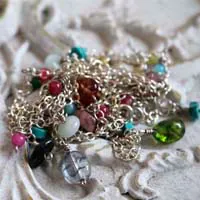
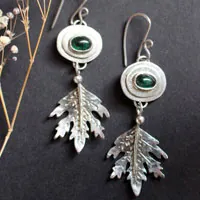
Green tourmaline jewelry samples
Sold
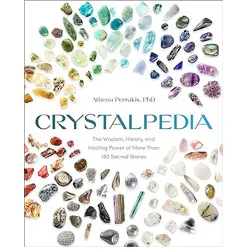
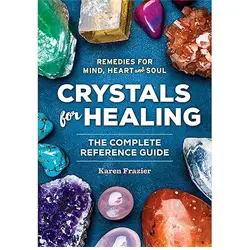
To learn more about litotherapy, we recommend you the following books:

OUR SERVICES
Customer reviews
Custom order
FAQ
Free shipping
Terms and conditions