







Citrine: history, healing properties and lithotherapy
Citrine properties

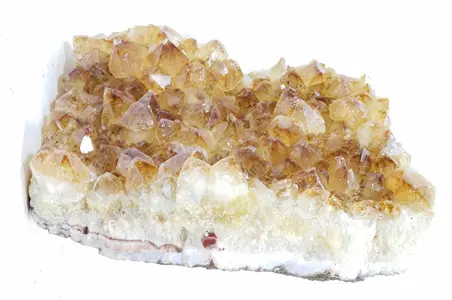
Citrine is a transparent quartz with shades ranging from pale yellow to intense golden hues. Its name derives from the Latin Citrus, referring to the color of lemon. Its characteristic shade is due to a low concentration of iron oxide (Fe³⁺) in its crystal structure, a phenomenon similar to that which creates different hues in other quartz varieties, like amethyst. Citrine has a hardness of 7 on the Mohs scale, making it resistant to scratches and ideal for everyday wear in jewelry.
Although widely appreciated for its beauty, natural citrine is relatively rare in nature. A large portion of the "citrines" available on the market are, in fact, heat-treated amethysts. When heated, their purple hue transforms into a golden yellow, sometimes with orange undertones. This distinction is subtle but essential: natural citrines generally display a softer color, closer to lemon yellow, whereas heat-treated amethysts tend to exhibit deeper shades, ranging from amber to orange.
The name "citrine" was formalized in 1556 by Georg Bauer, a German mineralogist also known as Georgius Agricola. Before that, this stone was known by various names, including "yellow quartz." Other names have also emerged over the centuries: yellow hyaline quartz, Bohemian topaz, quartz topaz, Cairngorm, Madeira topaz, Bahia topaz, Palmyra topaz, Salamanca topaz, Spanish topaz, golden topaz, or even saffronite. These multiple denominations underscore the fascination citrine has held throughout the ages.
The main deposits of natural citrine are found in Brazil, Russia, Madagascar, and the United States. These regions are known for producing high-quality specimens, particularly Brazilian citrines, prized for their bright hues and exceptional clarity. Citrine crystallizes in the rhombohedral system, often forming prismatic crystals with striated faces, a feature that can help differentiate it from imitations.
History, beliefs and legends about citrine
In antiquity and the Middle Ages, citrine was often confused with topaz, a common mistake due to their visual similarity. This confusion arose because, although the two stones belong to different mineral families (quartz for citrine and silicate for topaz), they share similar yellow hues. This misidentification led to citrine being used in ornaments considered to be topaz, allowing those who could not afford the precious topaz to have equally elegant jewelry at a lower cost. This mix-up closely linked the history of the two stones, influencing their perception throughout the ages.
The ancient Egyptians associated citrine with the goddess Sekhmet, the lion-headed warrior deity, symbolizing protection and solar strength. Citrine, with its golden glow, was seen as a solar talisman offering vigor and vitality. Many citrine jewels and amulets were worn to invoke Sekhmet’s protection against diseases and evil influences. This connection to the sun and protection strengthened citrine’s role in Egyptian rituals.
By 300 BCE, citrine was also used in ancient Greece, where it was dedicated to Demeter, the goddess of the earth, harvests, and fertility. Its bright glow, reminiscent of the sun and summer warmth, made it an ideal stone to celebrate the abundance of crops and the cycle of life, from fertility to prosperity. The Greeks wore citrine not only to attract material wealth but also to symbolize fertility and the generosity of nature.
Some scholars identify citrine as one of the gemstones on the breastplate of Aaron, mentioned in the Bible, specifically in the Book of Exodus. It is sometimes referred to as Chrysolitus or the "golden stone." However, the precise identification of this stone remains debated, with some experts suggesting it could be topaz or beryl. Nevertheless, this biblical ambiguity adds a mysterious and spiritual dimension to citrine, linking it to ancient religious traditions.

In the 19th century, with the rise of Art Deco and the rise of high-end jewelry during the interwar period, citrine experienced a resurgence in popularity. Its golden hues perfectly complemented the bold, geometric aesthetics of the time. Hollywood stars of the 1920s and 1930s, such as Greta Garbo and Joan Crawford, wore citrine jewelry, adding a touch of luminous elegance to the red carpets. This renewed interest solidified citrine as a symbol of glamour and sophistication.
This gemstone also holds astrological significance, being the birthstone associated with November, alongside topaz.
It is also the anniversary stone for the 13th year of marriage, symbolizing durability and warmth in the relationship. With its warm glow, citrine evokes light, solar energy, and joy—qualities often associated with the evolution of a romantic relationship over time.
In addition to its astrological and marital ties, citrine has been historically regarded as a stone of abundance and prosperity. It is considered a stone of positive energy and transformation, often worn to attract material wealth and success. Modern beliefs also attribute to it the ability to enhance mental clarity and focus, further reinforcing its role in spiritual practices and meditation.
Main deposits: Germany, Austria, Madagascar, Brazil, Russia, USA, and Spain.
Healing properties and benefits of citrine
Over the long course of history, people have attributed various properties, virtues, and healing beliefs to citrine. The elements presented here are part of a cultural and historical approach, intended to illustrate the symbolic relationship that has gradually developed between this stone and different civilizations over the centuries. As with the stones discussed previously, this information follows a scientific and historical perspective. It does not constitute medical or therapeutic advice and does not reflect our personal beliefs.
- Citrine is traditionally mentioned for its supposed connection with the body’s elimination functions, particularly in relation to the liver, bladder, pancreas, and gallbladder. In some traditions, it is described as a symbol of purification and internal clarity, associated with the release of toxins and a better balance of internal functions.
- Citrine is also mentioned for its role in supporting metabolism. It is associated with more harmonious digestion and improved regulation of internal imbalances, particularly those linked to hormonal variations and biological rhythms.
- In several traditions, citrine is linked to the harmony of the endocrine system. It is especially associated with thyroid balance and a more coherent regulation of hormone production, an equilibrium symbolically connected to the management of fatigue, stress, and body weight.
- Through its image as a luminous and dynamic stone, citrine is often associated with vitality and endurance. It is mentioned as a support during periods of chronic fatigue or exhaustion, accompanying renewed energy and greater stability of vital forces in everyday life.
- Citrine is also linked, in certain traditions, to the improvement of outward appearance. It is associated with smoother circulation and a body perceived as better balanced, which explains its association with skin, hair, and nail vitality. It is sometimes mentioned for soothing skin irritations, inflammation, or manifestations such as acne, always within a traditional framework.
- In the digestive sphere, citrine is frequently mentioned for its role in accompanying stomach discomfort. It is associated with easing digestive troubles, food intolerances, bloating, and intestinal discomfort, contributing to a more serene relationship with food.
- When used in practices such as elixirs, citrine is sometimes associated with support for the female cycle. It is mentioned in connection with menstrual periods, cramps, or emotional fluctuations, as well as menopausal phases, including hot flashes, fatigue, or perceived imbalances in bodily rhythms.
- Citrine is also associated with mental clarity. In several traditions, it is described as supporting concentration, memory, and creativity, making it a stone linked to intellectual activities, learning, and reflection, both in professional and academic contexts.
- On an emotional and symbolic level, citrine is often referred to as the stone of abundance. It is associated with joy, optimism, and self-confidence, as well as the ability to dissipate negative energy. It symbolically accompanies the overcoming of fear, anxiety, and doubt, encouraging a clearer, more stable, and more confident outlook on oneself and the future.
- In some complementary traditions, citrine is also linked to motivation, decision-making, and self-assertion. It is perceived as a support during periods of change, encouraging autonomy, determination, and a more conscious relationship with personal goals and aspirations.



 Please note that all healing properties attributed to stones come from ancient traditions and various cultural sources. This information is provided for informational purposes only and does not constitute medical advice. In case of any health concerns, it is recommended to consult a qualified professional.
Citrine jewelry samples

Sold











To learn more about litotherapy, we recommend you the following books:



OUR SERVICES
Customer reviews
Custom order
FAQ
Free shipping
Terms and conditions