







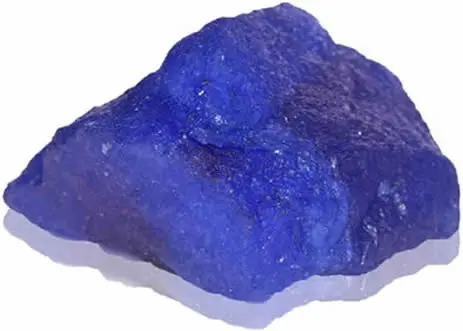
Blue sapphire: history, healing properties and lithotherapy
Blue sapphire properties

Blue sapphire, a prized gemstone, is a variety of corundum displaying a distinctive hue due to the combined presence of iron and titanium in its crystalline structure. This subtle combination gives each stone a unique shade, ranging from deep blue to sky blue, with intermediate variations such as royal blue or velvety blue.
When one simply mentions "sapphire," it is generally the blue sapphire that comes to mind, as its renown and brilliance have left a lasting mark on the history of jewelry and gemology. Its prestige dates back to antiquity, where it was already considered an exceptional gemstone, associated with deities and royalty.
With a hardness of 9 on the Mohs scale, the blue sapphire is one of the most durable stones after diamond, making it a popular choice for jewelry and precious ornaments. Its crystals, belonging to the trigonal system, often form hexagonal prisms that may contain natural inclusions, such as rutile needles responsible for the asterism effect observed in some star sapphires.
The color of blue sapphire is influenced by the quantity and distribution of iron and titanium within the crystal lattice. Kashmir sapphires are renowned for their deep, velvety blue hue, while those from Sri Lanka exhibit lighter shades, often described as "sky blue." Other deposits, such as those in Madagascar, Thailand, and Australia, offer sapphires in a range of tones, from dark blue to slightly violet-blue.
Optically, blue sapphire can exhibit fluorescence under ultraviolet light, though this effect varies depending on the stone’s origin and chemical composition. Some gemstones also display the phenomenon of dichroism, revealing blue-green or blue-violet reflections depending on the angle of observation.
Finally, blue sapphire is a stable and chemically resistant stone, highly resistant to prolonged sun exposure and ordinary temperature variations. However, like all gemstones, it can be altered by heat treatments designed to enhance its color— a common practice in the gemstone trade.
Main deposits: Burma, Kashmir, Sri Lanka, Australia, Thailand.
History, legends and beliefs about blue sapphire
When one thinks of sapphire, it is often the blue sapphire that comes to mind, overshadowing the other shades of this precious stone. Its history is marked by prestige and powerful symbolism throughout the ages. Many civilizations have regarded it as a divine gem, associated with kings, priests, and sages. To learn more about the fascinating history of this precious stone, we invite you to explore the page dedicated to sapphire as a whole.
But here is a brief summary of blue sapphire:
The origin of the name "sapphire" dates back to the Latin sapphirus, itself derived from the Greek sappheiros, which likely referred to lapis lazuli in ancient times. It was only during the Middle Ages that this term became firmly associated with the blue corundum we know today.
In ancient Egypt, blue sapphire was already a revered gemstone, considered a symbol of protection and divine wisdom. It is believed that some pharaohs and high-ranking officials wore it as an amulet or jewelry to attract the favor of the gods.
The Romans and Greeks of antiquity believed that blue sapphire provided a connection to the heavens. It was the stone of Jupiter (Zeus in Greek mythology), representing justice, power, and clarity of mind. It was also used as a talisman for protection against evil and envy.
During the Middle Ages, blue sapphire gained a central role in royal and religious insignia. It adorned crowns, scepters, and episcopal rings. Clergy members and monarchs believed it enhanced their wisdom and righteousness. This stone was also used by Christian clergy as a symbol of purity and faith, strengthening the bond between the faithful and the divine.
In Eastern traditions, particularly in India and Sri Lanka, blue sapphire was regarded as a lucky stone, believed to attract fortune and ward off negative influences. Vedic astrologers associated it with Saturn (Shani), linking it to karma and destiny.
Later, in the Victorian era, blue sapphire became an emblematic stone of love and fidelity. It was often given in engagement rings to symbolize sincere and enduring commitment.
Throughout history, blue sapphire has consistently represented truth, sincerity, and loyalty in human relationships. It is also believed to bring peace, joy, and wisdom to its wearer, guiding them toward a more harmonious and spiritual existence.
Healing properties and benefits of blue sapphire
Throughout the long history of humanity, many societies have attributed various properties, virtues, and interpretations of a curative or symbolic nature to blue sapphire. The elements presented here are part of a cultural and historical approach, intended to illustrate the symbolic relationship that has gradually developed between this stone and human civilizations over the centuries. As with previous examples, this information follows a scientific, historical, and descriptive perspective. It does not constitute any form of therapeutic or medical recommendation and does not reflect personal beliefs.
The general properties of corundum are discussed on the page dedicated to sapphire. This text focuses more specifically on blue sapphire, whose color and particular symbolism have, over time, encouraged associations related to calmness, mental clarity, and the search for inner harmony.
- In many traditions, blue sapphire has been viewed as a stone with soothing qualities, associated with the calming of thoughts and the reduction of mental agitation. It was sometimes mentioned as a support in contemplative or meditative practices, fostering a deep state of calm and improved quality of rest. Some sources refer to its use among people prone to insomnia or disturbed dreams, with the idea of creating an atmosphere conducive to sleep and nighttime serenity.
- Since Antiquity, blue sapphire has frequently been associated with clarity of vision, both on a physical and a symbolic level. In certain traditions, it was linked to the relief of eye strain, improved visual comfort, and support during recovery from eye ailments. Ancient accounts mention the practice of placing blue sapphire on the eyelids to soothe tired or irritated eyes, in an interpretation connected to the coolness and clarity of its color.
- Because of its association with calmness and mental balance, blue sapphire has also been mentioned as a support in cases of headaches, migraines, and cranial pain related to stress or intellectual overload. Some traditions associated it with a calming influence on the nervous system, attributing to it a role in managing anxiety, emotional tension, and persistent states of nervousness.
- Within certain traditional practices, blue sapphire was sometimes associated with the regulation of body temperature and the soothing of internal inflammations. It is mentioned in uses intended to accompany febrile states. Some sources also refer to its connection with coagulation and the limitation of bleeding, particularly nosebleeds, when it was worn or placed in contact with the skin.
- Blue sapphire is also associated, in several traditions, with inner ear balance and hearing. It was sometimes mentioned as a support for hearing and balance, particularly in cases of dizziness or sensations of disorientation. Certain ancient beliefs attributed to it a role in easing tinnitus and accompanying discomfort related to ear conditions.
- As a stone of balance and fluidity, blue sapphire has often been regarded as a support for the nervous system, encouraging overall relaxation and better stress management. It has also been associated with blood circulation, in an interpretation aimed at preventing certain imbalances linked to poor organ perfusion or stagnation of internal flows.
- In some traditions, blue sapphire has been mentioned as a stone associated with skeletal strength. It is occasionally described as an accompaniment for strengthening bones and easing joint pain, particularly in cases of arthritis or chronic stiffness.
- More marginally, there are also references to a possible role of blue sapphire in limiting the perceived impact of electromagnetic waves on the body. This interpretation remains relatively uncommon and belongs more to contemporary readings than to ancient traditions.
- Beyond the notions of fidelity and sincerity often associated with it, blue sapphire has sometimes been perceived as a mediator in human relationships. Some sources attribute to it the ability to ease tensions in friendships, family relationships, or professional settings, by encouraging dialogue, mutual understanding, and calm expression of emotions.
- Although it is frequently associated with concentration, wisdom, and intellectual rigor, blue sapphire has also been linked, in certain traditions, to inspiration and creativity. It was sometimes worn by artists, writers, or thinkers, with the idea of fostering clear, structured, and harmonious expression of ideas.
- Finally, the symbolic properties generally attributed to the color blue reinforce the interpretations associated with blue sapphire. This hue is traditionally linked to calm communication, serenity, inner depth, and a form of protection against influences perceived as negative or disruptive.



 Please note that all healing properties attributed to stones come from ancient traditions and various cultural sources. This information is provided for informational purposes only and does not constitute medical advice. In case of any health concerns, it is recommended to consult a qualified professional.
Blue sapphire jewelry samples

139.00 €
(≈ 155.68 USD)

To learn more about litotherapy, we recommend you the following books:



OUR SERVICES
Customer reviews
Custom order
FAQ
Free shipping
Terms and conditions